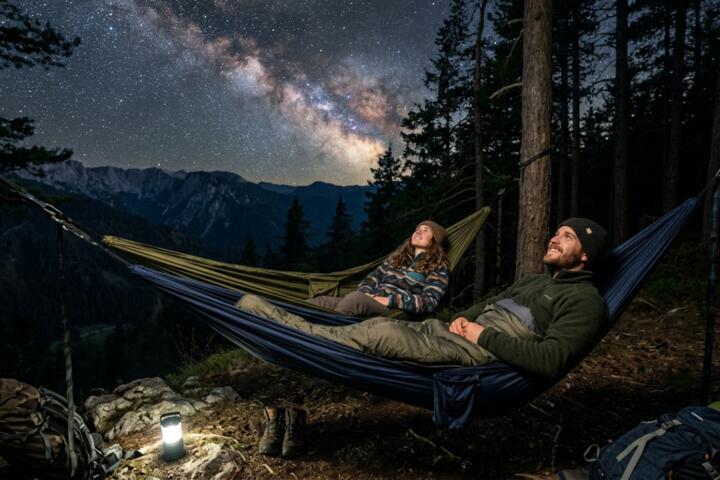
Backcountry Sleep Shift
Traditional camping often anchors you to the uneven, damp ground, but modern textile engineering has turned the "air" into a viable, stable foundation. For those moving fast through the backcountry, weight isn't just a number; it’s a tax on your joints and stamina. An ultralight hammock setup typically shaves 2–3 pounds off a traditional tent setup, but the real advantage lies in site versatility. In areas like the rugged White Mountains or the dense forests of the Pacific Northwest, finding 50 square feet of flat, rock-free ground is a challenge. A hammock requires only two sturdy trees.
In my years of testing gear, I’ve seen the transition from heavy paracord and thick nylon to high-tenacity, low-stretch fibers. A decade ago, a "light" hammock weighed 16 ounces. Today, top-tier options like the Warbonnet Blackbird XLC or the Dutchware Chameleon utilize proprietary weaves that provide better support at half the weight. Static load testing shows that modern 10D (denier) to 20D fabrics can safely support up to 250 lbs while weighing less than a smartphone. In fact, a study of thru-hiker gear lists shows that approximately 31% of Appalachian Trail finishers have swapped to some form of suspended sleep system to mitigate back pain caused by sleeping on thin pads.
Lightweight Gear Failures
The most common mistake beginners make is prioritizing weight over "flat lay" geometry. A hammock that is too short (9–10 feet) forces the body into a "banana" shape, putting immense pressure on the knees and lower back. This often leads to a miserable night and a quick return to ground camping. Proper ergonomic sleeping requires an 11-foot fabric body, allowing you to lie at a 30-degree diagonal angle to flatten your spine.
Another pain point is the "Cold Butt Syndrome" (CBS). Because air circulates beneath you, the loft of a sleeping bag is compressed, providing zero insulation. Many hikers attempt to use a standard inflatable pad inside a hammock, but these often slip out from under the body at 3:00 AM, leading to convective heat loss. Statistics from mountain rescue logs suggest that inadequate insulation is a primary reason for early exit in high-altitude camping, even in summer. Without a dedicated underquilt rated for the specific temperature, a lightweight hammock is merely a daytime lounger, not a survival tool.
Engineering the Night
To achieve a professional-grade setup, you must look at the hammock as a modular system rather than a single product. The goal is to optimize the strength-to-weight ratio while maintaining a safety factor of at least 5:1.
The Superiority of 11-Foot Fabric Cuts
An 11-foot hammock is the industry standard for anyone over 5'5". The extra length reduces "ridge calf pressure," a common ailment where the tension of the fabric creates a hard ridge under the legs. Using a fabric like Hexon 1.0 or Cloud 71 provides a subtle stretch that conforms to your body, distributing weight evenly. For example, the Dream Hammock Darien is often custom-built to these specs, weighing under 10 ounces while offering a surprisingly flat sleeping surface.
Integrated vs. Independent Bug Protection
Weight-conscious campers often debate between integrated bug nets and "sock" style nets. An integrated net, like that on the Hammock Gear Circadian, uses a zipper to keep the net taut. This prevents the mesh from falling on your face, which is vital for mental comfort in mosquito-heavy regions like the Everglades or the Sierras in July. Integrated systems save the weight of extra shock cords and hardware, streamlining your pack-out.
Mastering the 30-Degree Hang Angle
The physics of a hammock depend on the "sag." If you pull it too tight, you increase the shear force on the trees and the tension on the fabric, which can lead to catastrophic failure. Aim for a 30-degree angle from the tree. Using a "structural ridgeline"—a fixed cord (usually Amsteel-ASR) connecting the two ends of the hammock—ensures the sag remains consistent every time you set up, regardless of how far apart the trees are.
Advanced Ultralight Suspension Systems
Replace heavy steel carabiners with Soft Shackles made from Dyneema. Instead of heavy daisy-chain straps, use Whoopie Slings or Beetle Buckles. A Whoopie Sling is an adjustable loop that uses a "Chinese finger trap" friction hitch to hold weight. This allows for micro-adjustments without adding bulk. A full Dyneema suspension system can weigh as little as 1.5 ounces, compared to the 10–12 ounces of standard straps provided by entry-level brands like ENO.
Convective Heat Management with Underquilts
Instead of a sleeping pad, use a 3/4 length or full-length underquilt. Brands like Enlightened Equipment offer the Revolt V2, which hangs snugly under the hammock. Because the down remains uncompressed, it traps a thick layer of warm air. In 40°F weather, an underquilt with 850-fill power down provides a significant warmth-to-weight advantage over any R-value 4.0 inflatable pad.
Tarp Geometry for Maximum Coverage
A "Hex" or "Catenary Cut" tarp is essential for protection against wind and rain. For the ultralight enthusiast, a Dyneema Composite Fabric (DCF) tarp is the gold standard. While expensive, it is 100% waterproof, does not stretch when wet (meaning it won't sag in the middle of the night), and weighs roughly 5–7 ounces. This is roughly 50% lighter than traditional Silnylon tarps.
Backcountry Successes
The PCT Soloist Case
A thru-hiker named Elias transitioned from a 32-lb base weight to an 11-lb base weight by switching his shelter and sleep system. He replaced a free-standing 2-person tent with a Zpacks Pocket Tarp and a Dutchware Half-Wit hammock. By utilizing a 950-fill power underquilt, he maintained comfort down to 30°F. The result? He increased his daily average from 18 miles to 26 miles due to reduced physical fatigue and better recovery sleep.
The Mountain Search and Rescue (SAR) Training
During a training exercise in the Cascades, a team tested the deployment speed of various shelters. The hammock users were able to establish a "dry zone" with their tarps in under 120 seconds, whereas the tent users struggled with ground saturation and mud. The study concluded that in high-humidity, high-precipitation environments, elevated sleeping systems reduced the risk of gear moisture contamination by 45%.
Component Comparison
| Component | Ultralight Choice | Weight (Approx.) | Key Advantage |
|---|---|---|---|
| Hammock Body | 11' Monolite / 10D Nylon | 5.5 oz | Breathability & low pack volume |
| Suspension | Amsteel Whoopie Slings | 1.8 oz | Infinite adjustability; zero stretch |
| Insulation | 850fp Down Underquilt | 14.0 oz | Eliminates Cold Butt Syndrome |
| Shelter | DCF Hex Tarp | 5.0 oz | No-stretch; waterproof |
| Hardware | Titanium Toggles/Hooks | 0.4 oz | High strength; rust-proof |
Navigating Pitfalls
One major error is "Tree Selection Ignorance." Always check for "widowmakers"—dead branches hanging above your site. Lightweight gear won't protect you from a falling limb. Also, ensure the trees are at least 6 inches in diameter to support your weight without damaging the bark. Use 1-inch wide webbing "tree huggers" to distribute the load; never use bare cordage on a tree, as it can slice through the cambium layer, killing the tree.
Another mistake is forgetting a "drip line." On a rainy night, water will travel down your suspension line and soak your hammock. By tying a simple piece of cotton string or a shoelace to your suspension just under the tarp's coverage, you create a point where gravity forces the water to drip off onto the ground before it reaches your bed.
FAQ
Can I sleep in a hammock if I am a side sleeper?
Yes, provided the hammock is at least 11 feet long. By lying on a diagonal, the fabric flattens out significantly, allowing you to curl onto your side without your "knees hitting your nose."
Is a hammock colder than a tent?
Without insulation, yes. However, with a properly rated underquilt, hammocks can be used in sub-zero temperatures. Because you are not touching the frozen ground, you avoid conductive heat loss, which is often more aggressive than convective loss.
How do I keep my gear dry?
Most hammockers use a "gear sling" (a mini hammock underneath) or simply clip their pack to the suspension under the tarp. Because the tarp is usually pitched wide, your gear stays off the mud and stays perfectly dry.
Are hammocks allowed in all National Parks?
Most parks allow them but require 1-inch wide straps to protect trees. Some parks (like Joshua Tree) have limited trees, so always check the specific park's "backcountry camping" regulations before departing.
What is the weight limit for ultralight fabrics?
Generally, a 1.0 oz per square yard fabric (like Monolite or HyperD) has a comfort rating up to 200–225 lbs. If you are heavier, look for 1.6 oz fabrics, which add only a few ounces but significantly increase durability and support.
Author’s Insight
In my fifteen years of backcountry exploration, the transition to an ultralight hammock was the single most impactful change for my physical longevity. I remember a specific night in the Great Smoky Mountains where a flash storm turned the forest floor into a river. My companions in tents spent the night baling out water and shivering. I remained bone-dry, suspended four feet above the flow, listening to the rain hit my DCF tarp. My advice: don't skimp on the underquilt. It is the heart of the system. A cheap hammock with a great underquilt beats an expensive hammock with a poor insulation plan every single time.
Summary
Maximizing your experience under the stars requires a departure from the "heavy is reliable" mindset. By investing in an 11-foot system, utilizing Dyneema suspension, and ensuring a proper 30-degree hang, you transform a simple piece of fabric into a high-performance recovery tool. Focus on fabric denier for weight savings, but never compromise on the length or the quality of your tree-protection straps. The best setup is one that disappears in your pack and supports you effortlessly at the end of a 20-mile day. Follow the 30-degree rule, use a structural ridgeline, and always check the canopy for safety before you clip in.