The Evolution of Precision Packing for Modern Aviation
Navigating international transit hubs like Heathrow or JFK requires more than just a clear bag; it requires a deep understanding of volume optimization. For the modern professional traveler, the goal is "frictionless mobility." This means your hygiene essentials must occupy the smallest possible footprint without sacrificing the quality of the products you use.
In my years of consulting for long-haul commuters, I’ve seen that the difference between a seamless security check and a secondary screening often comes down to 10 milliliters of fluid. According to SITA’s 2024 insights, baggage handling issues and security delays are top stressors for 72% of international travelers. A well-engineered kit isn't just about saving space—it’s about psychological readiness and time management.
A practical example: A standard 100ml bottle takes up significant "dead air" in a quart-sized bag once it is half-empty. Switching to collapsible silicone tubes or solid-state alternatives allows you to fit 30% more items into the same TSA-mandated volume.
The High Cost of Poorly Organized Carry-On Essentials
The most common mistake travelers make is "volume inflation." They buy "travel-sized" products that are still too large for their actual needs, leading to a crowded 3-1-1 bag that is difficult to zip and prone to leaking under pressure. When a bag is overstuffed, the TSA agent cannot easily identify the contents, which triggers a manual search, adding an average of 8–12 minutes to your transit time.
Another pain point is the "leakage catastrophe." Atmospheric pressure changes in the cabin can cause rigid plastic bottles to fail. I once witnessed a traveler lose a high-end $200 tailored blazer because a poorly sealed bottle of facial oil expanded and leaked through their entire kit. The financial and logistical consequences of a messy kit are far higher than the cost of high-quality vessels.
Furthermore, many travelers rely on hotel-provided amenities. However, these are often high in sulfates and artificial fragrances, which can cause skin irritation during the dry, recirculated air of a 10-hour flight. Relying on "luck" at the destination is not a strategy for the disciplined traveler.
Engineered Solutions for Maximum Portability
Transitioning to Solid-State Grooming
The most effective way to beat liquid restrictions is to remove the liquid entirely. Modern cosmetic chemistry has advanced to the point where solid shampoos, conditioners, and toothpastes are no longer "niche" products—they are high-performance tools.
- Action: Replace liquid soaps with concentrated bars and swap toothpaste for fluoride tablets (like those from Bite or Lush).
- Result: You bypass the 3-1-1 bag entirely for these items, leaving more room for essential serums or sunscreens.
- Efficiency: A single 2oz shampoo bar typically lasts for 80 washes, equivalent to three standard liquid bottles.
Utilizing Decanting Systems for Precision
Don't carry the bottle the product came in. Professional organizers use "decanting"—transferring only what is needed for the specific duration of the trip.
- Tool: Use Matador FlatPak bottles. Unlike rigid cylinders, these are made of Cordura fabric and shrink as you use the product.
- Strategy: For a 3-day trip, you likely only need 15ml of moisturizer, not 100ml. Use 5ml "sample jars" or contact lens cases for high-viscosity creams.
- Metric: This can reduce the weight of your kit by up to 1.5 lbs on a week-long journey.
Strategic Selection of Micro-Tools
Standard brushes and razors are designed for bathroom counters, not compact pouches. Look for "folding" or "nesting" designs.
- Example: The Gillette Venus Mini or the Quip folding toothbrush offer full-sized utility with a 50% smaller storage profile.
- Integration: Choose a micro-fiber towel (like those from Sea to Summit) which packs down to the size of a lemon but absorbs four times its weight in water.
Environmental Pressure Management
To prevent leaks, use the "squeeze and seal" method. Before closing a silicone tube, squeeze out the excess air. This creates a vacuum that allows the fluid to expand as cabin pressure drops without forcing the cap open.
- Safety Tip: Always use "lockable" pumps or screw-on lids rather than flip-tops for high-altitude travel.
Multi-Functional Product Integration
Efficiency is found in products that serve dual purposes. A high-quality SPF moisturizer eliminates the need for two separate bottles. A tinted lip balm serves as both hydration and light cosmetic coverage.
- Selection: Look for "3-in-1" soaps (hair, body, face) specifically formulated for travelers, such as Dr. Bronner’s Pure-Castile Liquid Soap, which is highly concentrated; 5ml can last for two days of showering.
Real-World Scenarios: Efficiency in Action
Case Study 1: The Executive Commuter
- Subject: A consultant traveling between London and Singapore 15 times per year.
- Problem: Frequent "Secondary Screenings" due to a cluttered, oversized leather washbag.
- Intervention: Switched to a transparent Cadence Capsule system. These are magnetic, leak-proof, and custom-labeled.
- Outcome: Security transit time reduced from 15 minutes to under 5 minutes. The modular design allowed for a "pick and pack" system based on trip length, reducing total kit volume by 55%.
Case Study 2: The Minimalist Backpacker
- Subject: A digital nomad moving every two weeks across Europe with only a 25L pack.
- Problem: Liquid leaks ruining expensive electronics and camera gear.
- Intervention: Implemented a "Zero-Liquid" policy using Ethique solid bars and a Matador Soap Bar Case (which allows bars to dry through the fabric).
- Outcome: Eliminated the 3-1-1 bag entirely. Weight savings totaled 1.2kg, making the bag compliant with strict low-cost carrier weight limits (typically 7kg).
Comparative Analysis of Containment Systems
| System Type | Best For | Space Efficiency | Leak Protection |
|---|---|---|---|
| Silicone Tubes (e.g., GoToob) | Viscous liquids (Shampoo) | Medium | High |
| Flat-Profile Fabric (e.g., Matador) | Low-profile packing | Extreme | High |
| Magnetic Capsules (e.g., Cadence) | Jewelry & Creams | High | Maximum |
| Standard Plastic Bottles | One-time use | Low | Low |
| Solid-State Bars | Long-term travel | Maximum | N/A (Dry) |
Common Strategic Errors to Avoid
Avoid buying "pre-filled" travel kits at the airport. These kits are often overpriced and filled with generic, low-quality products that contain excess water (fillers). You are paying for the plastic, not the product. It is always more efficient to buy high-quality containers and fill them with your preferred high-concentration products.
Never pack your 3-1-1 bag at the bottom of your carry-on. This is a fundamental error. It should always be in an external pocket or at the very top. Speed at the security belt is a courtesy to others and a stress-reducer for you.
Don't assume "TSA Compliant" on a label means "Space Efficient." Many TSA-approved bags are boxy and rigid. Look for flexible, TPU-based (thermoplastic polyurethane) bags which are more durable than PVC and can mold to the gaps in your luggage.
Essential Packing Checklist
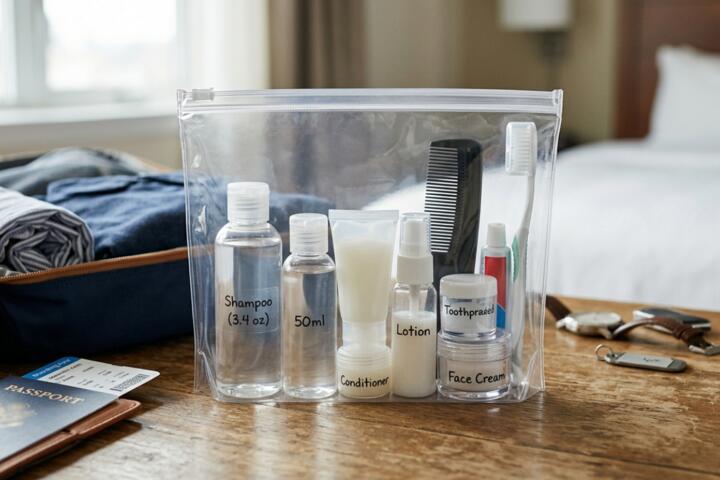
- Clear, 1-quart (1 liter) TPU bag with a durable zipper.
- Maximum of three 100ml vessels for "must-have" liquids.
- Solid-state alternatives for shampoo, conditioner, and toothpaste.
- Micro-fiber washcloth (dries in under 2 hours).
- Collapsible silicone cup for rinsing.
- Dual-voltage mini-trimmer or folding razor.
- Labels for every container (security hates mystery liquids).
Frequently Asked Questions
Does "solid" deodorant count as a liquid for TSA?
No. Solid stick deodorant is considered a solid and does not need to go in your clear quart-sized bag. However, gel or spray deodorants must comply with the 3.4oz (100ml) rule and be placed in the bag.
Can I bring more than one quart-sized bag?
Technically, the TSA "3-1-1" rule allows for one bag per passenger. While enforcement varies globally, it is best to consolidate all liquids, aerosols, and gels into a single bag to avoid delays.
Are silicone bottles better than plastic?
Yes, for most products. Silicone is pliable, allowing you to squeeze out every drop, and it handles pressure changes better than rigid plastic. However, avoid putting silicone-based hair serums in silicone bottles, as they can react and degrade the material.
How do I handle expensive perfumes?
Do not bring the full glass bottle. Use a "travalo" style atomizer. These tiny devices pump the fragrance directly from your main bottle into a 5ml spray, which is enough for about 50-60 sprays and takes up 90% less space.
What if my liquid medication exceeds 100ml?
Medically necessary liquids, such as insulin or certain cough medicines, are exempt from the 3-1-1 rule. You must declare them to the officer at the start of the screening process, and they may be subject to additional testing.
Author’s Insight
In my fifteen years of traveling for business, I have learned that "just in case" is the enemy of the compact traveler. Most people over-pack toiletries by at least 50%. My personal rule is the "72-Hour Reset." I only pack enough liquids for the first 72 hours of a trip. Unless you are going to a remote wilderness, you can almost always restock your basics at your destination. This mindset shift allowed me to move from a heavy checked bag to a single 18L backpack, saving me hundreds of hours in luggage wait times over the last decade.
Conclusion
Creating a compact, TSA-compliant toiletry kit is an exercise in intentionality. By prioritizing solid-state products, utilizing high-performance decanting vessels like those from Matador or Cadence, and eliminating "volume inflation," you transform your travel experience. Stop packing for a month when you are only traveling for a week. Invest in a high-quality TPU bag, embrace multi-functional products, and treat your packing list like a high-performance inventory. Your reward is a faster transit, a lighter bag, and a more focused journey.