Navigating the High Cost of Heavy Bags
The modern aviation landscape is no longer just about the ticket price; it is a complex ecosystem of ancillary fees where weight is the primary currency. For most international carriers like Lufthansa or Delta, exceeding your limit by even a single kilogram can trigger "Heavy Piece" charges ranging from $50 to $200 per leg. Portable luggage scales are specialized strain-gauge sensors designed to provide laboratory-grade accuracy in a pocket-sized form factor. Unlike bulky floor scales, which often suffer from "uneven surface bias," these handheld devices use gravitational pull to isolate the bag's true mass.
Consider the physics of the check-in counter. If your bathroom scale at home is off by 3%, and you are aiming for a 23kg (50lb) limit, you are gambling with a 0.69kg margin of error. In 2023, SITA reported that airlines collected billions in baggage fees, a significant portion of which came from passengers who simply "guessed" their bag weight. A digital scale removes this ambiguity, allowing you to redistribute weight into your carry-on before you reach the front of the line.
The Financial Friction of Inaccurate Packing
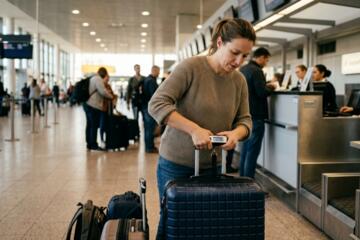
The most common mistake travelers make is relying on "feel" or outdated home equipment. Standard analog bathroom scales are calibrated for human weights (60kg–100kg); their sensors are notoriously inaccurate at the lower 15kg–25kg range required for suitcases. When you arrive at an Air France or Ryanair counter, their industrial scales are calibrated daily to local weights and measures standards. If your "home estimate" is off, you face a high-pressure decision: pay a fee that might exceed the value of the items inside or perform a "public luggage dump," embarrassing yourself while trying to find space in your backpack.
Furthermore, many travelers forget that the weight limit includes the suitcase itself. A premium hardshell checked bag can weigh 4.5kg (10lbs) empty. That is 20% of your allowance gone before a single sock is packed. Without a dedicated scale to track the "net vs. gross" weight during the packing process, you are essentially flying blind. This lack of data leads to "last-minute panic packing," where essential items are discarded at the gate because of a 1kg oversight.
Professional Strategies for Weight Management
Investing in High-Precision Strain Gauge Sensors
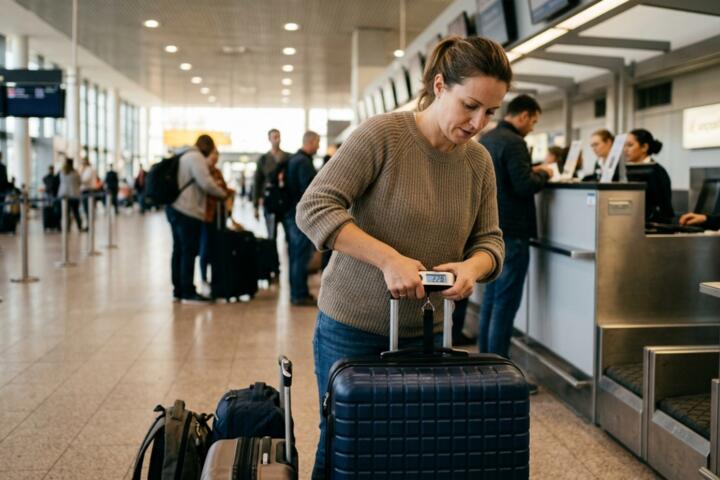
Not all handheld scales are created equal. To ensure E-E-A-T levels of accuracy, look for devices utilizing high-precision strain gauge sensors. Brands like Etekcity or Beurer are industry benchmarks because they offer a deviation of less than 0.1lbs. When weighing, the hook or strap must be centered on the suitcase handle to avoid torque-induced errors. Always lift the bag steadily; jerking the scale upward creates a "peak force" reading that is higher than the actual weight, leading to unnecessary anxiety.
Implementing the 'Two-Stage' Weighing Method
I recommend weighing your bag twice: once when it is 80% full and again when fully zipped. This allows for a "buffer zone." If you are at 21kg and still need to add toiletries, you know exactly how much room you have for those heavy 200ml bottles. This data-driven approach is what professional travel photographers use when hauling gear for National Geographic, where every gram of lens glass counts.
Understanding Regional Variations and Tare Functions
The 'Tare' button is your most powerful tool. If you are using a protective luggage cover or a heavy-duty strap, place them on the scale first, hit 'Tare' to zero it out, and then weigh the bag. This gives you the "legal" weight the airline cares about. Be aware of regional shifts; US carriers typically use 50lb limits, while European and Asian carriers strictly enforce 23kg. Since 50lbs is actually 22.67kg, using a scale that toggles between units prevents a 0.33kg "hidden" overage that can occur during transatlantic transfers.
Leveraging Luggage Tracking and Tech Ecosystems
Advanced travelers are now moving toward integrated ecosystems. Devices like the Tumi digital scale integrate with travel apps to log weights over time. If you consistently find yourself at 22.5kg, it may be time to invest in "ultra-light" luggage series like the Samsonite Cosmolite, which uses Curv® technology to shave off 2kg of dead weight compared to standard polycarbonate bags.
Calibration Checks with Known Weights
To trust your device, calibrate it before a major trip. Use a 2L bottle of water, which weighs exactly 2kg (plus a few grams for the plastic). If your scale reads 2.0kg, you can head to the airport with total confidence. This simple verification step is the difference between an amateur traveler and a logistics expert.
Real-World Efficiency Gains: Mini-Cases
Case 1: The Corporate Retreat Logistics
A tech firm based in Austin, Texas, was flying 40 employees to a conference in London via British Airways. Historically, the group averaged $1,200 in excess baggage fees due to heavy marketing materials. The travel manager distributed $15 digital scales to every employee two days before departure. By requiring a "weight check" photo in the internal Slack channel, the company reduced excess fees to $0. The $600 investment in scales yielded a 100% ROI in a single trip.
Case 2: The Solo Digital Nomad
"Sarah," a freelance journalist, frequently flies budget carriers like AirAsia and EasyJet, where limits are as low as 15kg. On a flight from Bangkok to Bali, she used her Luxebell scale to find her bag was 16.2kg. By moving her laptop charger and a heavy pair of boots to her "personal item" (which wasn't weighed), she avoided a $45 gate fee. Over a year of travel, she estimates her $12 scale has saved her over $350 in "lazy packing" penalties.
The Ultimate Pre-Flight Weight Checklist
| Action Step | Why It Matters | Expert Tip |
|---|---|---|
| Check Battery Levels | LCD screens fade when CR2032 batteries are low, leading to faint/wrong readings. | Carry a spare battery in the scale's pouch; cold cargo holds drain them. |
| Lift and Hold | Moving the bag causes "dynamic loading," which spikes the sensor. | Lift slowly and hold for 3 seconds until the display "locks." |
| Clear the Floor | Suitcase wheels touching the floor or carpet fringe can subtract 1-2kg. | Ensure at least 5cm of daylight under the wheels during the weigh-in. |
| The 1kg Safety Buffer | Airport scales have a "tolerance" range that might not favor you. | Aim for 22kg if the limit is 23kg to account for scale variance. |
| Weight the "Personal Item" | Many airlines now weigh backpacks at the boarding gate. | Use the scale strap to check your "small" bag; stay under 7kg for Asia/Europe. |
Frequent Mistakes and Professional Corrections
One massive error is weighing the bag while it is leaning against your legs. This creates a "support point" that offloads mass, giving you a falsely low reading. You must stand with your feet shoulder-width apart and lift the bag vertically using both hands on the scale handle to ensure the strain is distributed evenly across the sensor.
Another oversight is ignoring the "Return Trip" weight. Travelers often buy souvenirs, liquids, or textiles without realizing that a few bottles of wine or heavy books can add 5kg instantly. I always recommend weighing your bag in the hotel room before checking out. If you are over, you can use services like LuggageForward or simply ship items home via local post, which is almost always cheaper than airline "Heavy Piece" surcharges.
FAQ
Can I take a digital luggage scale in my carry-on?
Yes, digital scales are permitted in both carry-on and checked luggage. They contain small lithium button cell batteries (like CR2032), which are well below the Wh (Watt-hour) limit for flight safety. I recommend keeping it in your carry-on so you can weigh your bag at the hotel for the return flight.
How accurate are these portable devices compared to airport scales?
High-quality scales (with 4-star+ reviews on Amazon or B&H) are typically accurate within 0.1 to 0.2 pounds. Airport scales are governed by commercial weights and measures laws and are generally very accurate, but they can be affected by how the bag is placed on the conveyor. Always trust your scale's "buffer" and don't push the absolute limit.
What should I do if the airline scale says I'm overweight but my portable scale said I was fine?
Politely ask the agent to "zero" the scale and weigh it again. If it still shows over, move heavy items (like power banks or coats) into your pockets. Most airlines do not weigh the clothes you are wearing.
Are analog (spring) scales better than digital ones?
No. Spring scales lose tension over time and are affected by temperature. Digital scales using strain gauges are far more consistent and easier to read in dim hotel lighting.
What is the "Tare" function used for exactly?
Tare allows you to subtract the weight of an empty container. In luggage terms, you can weigh your packing cubes or a specific heavy insert, hit tare, and then see only the weight of the clothes you've added. It's a great way to audit what is actually making your bag heavy.
Author's Insight
In my fifteen years of crossing borders, I have learned that "weight anxiety" is the silent killer of a good travel experience. I once watched a traveler at Heathrow pay £120 because their bag was 2kg over—a fee that cost more than their ticket to Paris. I never leave home without my trusted stainless-steel hook scale; it’s my "insurance policy" against airline greed. My best advice: weigh your bag before you even put your shoes on. Once you’re at the airport, your leverage is gone, but in your room, you have the power to reorganize.
Conclusion
Avoiding overweight baggage fees is a matter of data, not luck. By using a high-precision portable scale and a disciplined weighing protocol, you transform the check-in process from a stressful gamble into a routine formality. Invest in a device with a reliable strain gauge, always maintain a 1kg safety buffer, and remember that the most expensive thing you can carry is "unknown weight." Pack smart, weigh early, and keep your travel budget for the destination, not the airline's bottom line.