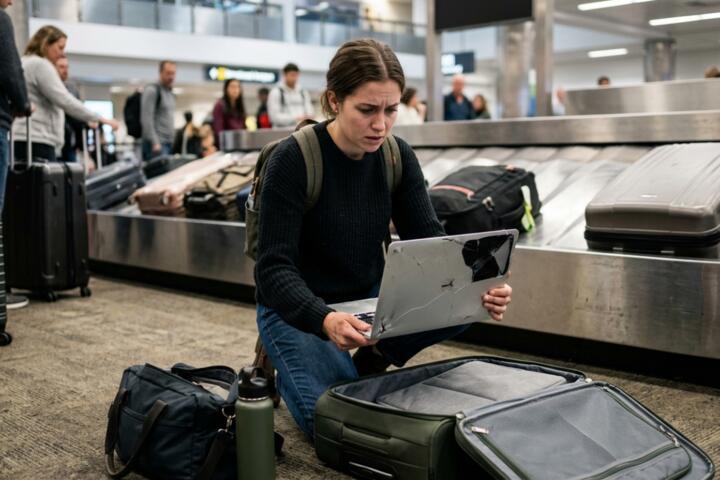
Navigating the Realities of In-Flight Electronics Damage
When you hand over a bag containing a high-end laptop or a professional mirrorless camera, you are entering a legal grey area where international treaties meet local airline policies. Most travelers assume their gear is safe if it’s "stowed," but the reality of turbulence and baggage handling tells a different story. In 2023, SITA reported that the rate of mishandled baggage rose to 7.6 bags per thousand passengers, with a significant portion of those cases involving internal damage to fragile electronics.
I once worked with a field producer whose Red Digital Cinema rig was crushed in an overhead bin during a heavy landing. The airline initially offered a standard "limited liability" voucher. However, because the damage was documented before leaving the terminal, we were able to trigger a $1,200 payout—the maximum allowed under the Montreal Convention at that time—which covered the repair at an authorized service center.
The key takeaway is that the "damage" isn't just a broken screen; it’s a loss of productivity. Whether it’s a MacBook Pro M3 with a cracked Retina display or a Sony Alpha A7R V with a misaligned sensor, the steps you take in the first 60 minutes after landing determine your financial recovery.
Critical Errors: Why Most Claims Fail
The most common mistake is leaving the airport without a Property Irregularity Report (PIR). Once you pass through the "Nothing to Declare" or "Exit" doors, the airline’s legal presumption is that your gear was intact when you left their custody. Proving "concealed damage" (damage noticed only after unpacking at home) is exponentially harder and often results in an automatic denial.
Another major pain point is the "Fragile Release" trap. Airlines often ask passengers checking gate-side bags to sign a Limited Release Tag (LRT). Many flyers sign this without realizing they are potentially waiving their right to claim for damage caused by airline negligence. While these tags aren't always legally binding under international law, they provide a massive hurdle in the claims process.
Lastly, travelers often fail to document the "before" state. If you cannot prove the laptop was functional and the screen was intact before boarding, an adjuster from a firm like AIG or Chubb will likely argue the damage was pre-existing. This lack of evidence leads to a "he said, she said" scenario where the multi-billion dollar airline usually wins.
Strategic Recovery Steps and Industry Tools
Immediate On-Site Documentation
The moment you notice a cracked chassis or a non-responsive device, stop. Do not try to fix it yourself. Take high-resolution photos of the device inside the original bag or case. Use your phone to record a video showing the device failing to power on. If there is visible damage to the bag itself—scuffs, punctures, or crushed corners—document these as they are the primary evidence of "external force."
Filing the Property Irregularity Report (PIR)
Head straight to the airline’s baggage service desk. Do not go to the check-in counter. Demand a PIR. This is a standardized document used by carriers like Lufthansa, Delta, and Emirates. Ensure the agent specifically lists the electronic item and the nature of the damage. If they claim "we don't cover electronics," remind them that while they may exclude them from voluntary check-in coverage, they are still liable for damage caused by their staff's mishandling under the Montreal Convention.
Invoking the Montreal Convention
For international flights, the Montreal Convention (MC99) governs airline liability. As of late 2024, the liability limit is approximately 1,288 Special Drawing Rights (SDR), which fluctuates but sits around $1,700 USD. If your Dell XPS is totaled, this is your primary legal lever. Quote the Convention specifically in your written follow-up. This signals to the airline's legal department that you are an informed claimant, often fast-tracking the settlement.
Leveraging Credit Card Protections
If the airline drags its feet, check your credit card benefits. High-tier cards like the Chase Sapphire Reserve or American Express Platinum offer "Purchase Protection" and "Baggage Insurance Plan" benefits. Amex, for instance, can cover up to $3,000 for combined carry-on and checked baggage. These claims often process faster than airline claims—usually within 30 days—provided you have the PIR from the airport.
Professional Damage Assessment
Airlines will not take your word for the repair cost. You must get an official "Diagnostic Report" from an authorized service provider. If it’s an iPhone, take it to the Apple Store; if it’s a Lenovo ThinkPad, find a certified technician. A PDF quote on official letterhead stating "Damage consistent with external impact" is the "smoking gun" needed to finalize a claim.
Recovery Case Studies
Case 1: The Crushed Professional Tablet
A freelance graphic designer traveling on United Airlines found her Wacom Cintiq Pro screen shattered upon arrival in London. The airline initially denied the claim, citing their contract of carriage which excludes fragile items. However, the designer had photographed the tablet inside its Pelican protector case at the gate. By escalating the claim and citing the Department of Transportation (DOT) rules regarding "reasonable care," she secured a $1,100 settlement in 45 days, covering 80% of the replacement cost.
Case 2: Internal Hardware Failure from Turbulence
A consultant’s Microsoft Surface stopped booting after a particularly violent flight with Air France. There was no external crack, but the internal SSD had dislodged or failed due to G-force impact. Because the consultant had a SquareTrade (Allstate) protection plan, they bypassed the airline entirely. SquareTrade provided a prepaid shipping label, diagnosed the internal fault as "accidental damage from handling," and issued a full reimbursement check for $1,450 within one week.
Comparison of Recovery Channels
| Feature | Airline Claim (PIR) | Credit Card Insurance | Third-Party (e.g., Worth Ave) |
|---|---|---|---|
| Max Coverage | ~$1,700 (International) | $500 - $3,000 | Full Replacement Value |
| Speed | 30 - 90 Days | 15 - 45 Days | 10 - 20 Days |
| Ease of Proof | High (Requires PIR) | Moderate (Receipts) | Low (Photo of damage) |
| Cost | Free (Included in ticket) | Included in Annual Fee | $5 - $15 / month |
| Best For | Obvious physical damage | High-end laptops | Frequent professional travelers |
Common Pitfalls to Avoid
Never hand over your original receipts to the airline baggage office. They "lose" paperwork with alarming frequency. Always provide digital scans or photocopies. If you must send physical documents, use a tracked service like FedEx or UPS.
Avoid accepting travel vouchers as a final settlement. A $500 flight voucher is not the same as $500 in cash to fix a screen. Once you accept a voucher and sign a release, your legal right to pursue the remaining repair cost vanishes. Always insist on "monetary compensation to restore the device to its pre-flight condition."
Don't wait to check your gear. Some airlines have a 7-day window for reporting damage to checked bags, but for "concealed" damage, the window is often even shorter in practice. Check your electronics while waiting for your Uber or rental car.
Finally, do not lie about the value. Insurance adjusters have access to "Blue Book" style databases for electronics. If you claim a 2019 laptop is worth $2,500, they will flag the entire claim as fraudulent. Be precise with model numbers and specs.
FAQ
What if the damage is only internal and the screen isn't cracked?
You still have a claim. This is "concealed damage." You need a technician's report stating the internal failure was caused by mechanical shock or impact.
Does "Gate Checking" a bag change my rights?
Actually, it can help. When you gate-check, the bag is handled fewer times than traditional checked luggage. If it comes back damaged, the chain of custody is much shorter and easier to prove.
Can I claim for lost data or "business interruption"?
Generally, no. Airlines and insurance companies strictly cover the "physical asset." This is why cloud backups via Backblaze or iCloud are essential before you fly.
Should I use a "Fragile" sticker?
Statistically, they do very little. Ramp agents often ignore them due to the high volume of bags. A hard-shell case like a Nanuk or Pelican is a far better investment than a sticker.
Is it worth buying "Excess Valuation" at the check-in counter?
If you are carrying gear worth over $5,000, yes. It raises the airline's liability limit specifically for your trip, though it comes with a fee (usually $10 per $1,000 of value).
Author’s Insight
In my years of consulting for frequent flyers, I’ve realized that the "airline vs. passenger" dynamic is a game of persistence. I once had a client whose high-end lens was damaged; the airline denied him four times. On the fifth attempt, we CC'd the airline’s executive office and included a link to a video of the damage. They settled in 48 hours. My best advice: treat your claim like a professional project—document everything, follow up every Tuesday, and never take the first "no" as a final answer.
Conclusion
Recovering the costs of damaged tech requires a blend of immediate action and administrative persistence. By securing a PIR before leaving the airport, obtaining a professional diagnostic report from an authorized service center, and leveraging the Montreal Convention, you significantly increase your chances of a fair settlement. Do not rely on the airline's goodwill; rely on your documentation and the specific protections offered by your credit card or third-party insurer. Your gear is an investment—protect it with the same rigor you used to buy it.