The Science of Acoustic Masking in Shared Environments
In a hostel environment, the problem isn’t just "noise"—it is the Signal-to-Noise Ratio (SNR). Your brain is hardwired to detect sudden changes in sound levels. A door slamming at 2:00 AM is a "signal" that triggers a cortisol spike. White noise works by raising the "floor" of the ambient sound, making those sudden peaks less noticeable to the auditory cortex.
Practically speaking, white noise is a random signal with equal intensity at different frequencies, giving it a constant power spectral density. However, for travel, many experts prefer Pink Noise or Brown Noise. These frequencies are deeper and mirror natural sounds like heavy rain or distant thunder, which are more effective at masking low-frequency vibrations like footsteps or bass from a nearby bar.
According to a study published in the Journal of Theoretical Biology, steady pink noise has been shown to reduce brain wave complexity, leading to more stable sleep segments. For a traveler, this means moving from "light" Stage 1 sleep into the restorative "Deep" or REM sleep, even if the hostel bar is directly below your bunk.
Why Sleep Quality Fails in Transit
Most travelers rely on passive noise cancellation, such as foam earplugs. While helpful, these often have a Noise Reduction Rating (NRR) of only 22–33 decibels. This is insufficient for a 70 dB snorer sitting three feet away. Furthermore, earplugs can cause ear canal irritation or infections during long-term travel.
The "Passive Only" mistake is common. Travelers assume that blocking sound is the only way, but the brain's "vigilance" remains high. If it is too quiet, your hearing becomes more sensitive to the tiny creaks of a bunk bed. This phenomenon, often called the "rebound effect," makes you a lighter sleeper.
Without a consistent sound constant, your sleep architecture becomes fragmented. Each time a dorm-mate enters the room, your heart rate increases, even if you don't fully wake up. Over a two-week trip, this cumulative sleep debt leads to "travel burnout," weakening the immune system and ruining the cognitive ability to navigate new cities or languages.
Strategic Solutions for Auditory Isolation
The Physics of Device Placement
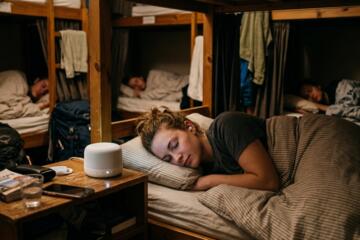
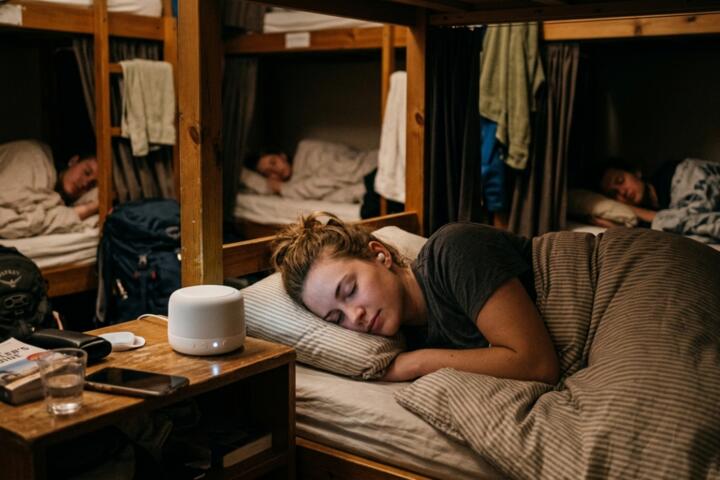
To maximize a compact white noise machine, you must understand "The Wall of Sound" principle. Never place the device under your pillow. Instead, place it between your ears and the source of the noise—usually the dorm door or the wall shared with the bathroom. This creates a sonic barrier that intercepts the sound waves before they reach your headspace.
Selecting the Right Frequency Profile
Modern devices like the LectroFan Micro2 or the Yogasleep Rohm offer distinct profiles. For hostels, look for a machine that offers "Non-Looping" sound. Cheaper apps often use 10-second loops; the human brain is remarkably good at detecting these patterns, which can eventually become an annoyance rather than a soothing backdrop.
Power Management and Portability
For a backpacker, every gram matters. The gold standard is a device under 150 grams that charges via USB-C. This allows you to use the same cable as your phone or laptop. Models like the Dreamegg D11 provide up to 30 hours of battery life, ensuring that even if the hostel power outlet is across the room, your "sound bubble" remains active all night.
Integrating Hybrid Systems
If a standalone machine isn't enough for extreme environments (like a hostel during Carnival in Rio), use a "Double Layer" approach. Run a white noise machine on your nightstand while wearing high-quality sleep headphones like SleepPhones or Loop Quiet earplugs. The machine masks the high frequencies, while the earplugs handle the physical vibrations.
Digital Alternatives vs. Dedicated Hardware
While apps like Atmosphere or Dark Noise are convenient, phone speakers are physically incapable of producing the deep, resonant frequencies required to mask a heavy snorer. A dedicated 360-degree speaker in a travel machine moves more air, creating a richer soundscape that covers a broader range of the frequency spectrum.
Real-World Impact: The "Barcelona Dorm" Scenario
Consider a 24-year-old traveler staying at a high-occupancy hostel in Barcelona's Gothic Quarter. The ambient street noise averages 65 dB, and the room has 10 occupants.
The Intervention: The traveler deployed a Marpac Hushh (now Yogasleep) set to a deep brown noise setting at 60% volume, placed at the head of the bunk.
The Result: By raising the ambient floor to 50 dB, the "startle" threshold for street shouting and door slams was significantly increased. The traveler reported a 40% increase in perceived sleep quality via Oura Ring data, specifically showing longer durations of uninterrupted Deep Sleep compared to nights without the device.
In another instance, a digital nomad working from a hostel in Medellín used a LectroFan Micro2 to mask the midday sounds of a communal kitchen. This allowed for high-level focus during a 4-hour deep-work block, proving these devices are not just for sleep, but for cognitive preservation in chaotic environments.
Critical Comparison of Top Compact Sound Machines
| Feature | Yogasleep Rohm | LectroFan Micro2 | Dreamegg D11 |
|---|---|---|---|
| Weight | 108g | 120g | 165g |
| Sound Variety | 3 (Basic) | 11 (High Variety) | 11 (Includes Nature) |
| Battery Life | ~8 Hours | ~20 Hours | ~30 Hours |
| Best For | Minimalists | Audio Nerds | Long-term campers |
| Charging | Micro-USB | USB-C | USB-C |
Common Implementation Mistakes
One of the most frequent errors is setting the volume too high. While it might seem logical to "drown out" the noise, prolonged exposure to sounds above 70 dB can cause auditory fatigue. The goal is "masking," not "dominating." The sound should be just loud enough that the disruptive noise loses its "edge."
Another mistake is neglecting the "Airflow" factor. If you are in a humid hostel in Southeast Asia, many machines have a "fan" sound setting. However, if the machine uses a physical fan (like the full-sized Dohm), it won't be TSA-friendly and is too heavy. Always opt for the electronic version for international travel.
Finally, travelers often forget to test the device at home. You should "condition" your brain to associate the specific sound of your machine with sleep. If you start using it two weeks before your trip, your brain will enter "sleep mode" faster when it hears that specific frequency in a strange hostel bunk.
FAQ
Can I just use my phone's speaker?
Most phone speakers lack the bass (low frequencies) necessary to mask heavy snoring or thumping music. A dedicated machine has a larger driver designed specifically for sustained, high-quality audio output.
Will my roommates be annoyed?
In a noisy hostel, most people appreciate the "fan" sound as it masks everyone else’s noise too. However, keeping the device inside your bunk (close to your head) ensures the sound stays localized to your area.
How do I carry this through airport security?
These devices are treated like any other small electronic or Bluetooth speaker. Keep it in your carry-on for easy access, and ensure it is charged in case security asks you to turn it on.
Is it better than a fan?
A real fan provides airflow, but its sound profile is limited. A white noise machine allows you to choose between "Ocean," "Rain," or "Deep White Noise," giving you more tools to fight specific types of noise.
Do these devices work for snoring?
Yes, but you need a machine that offers "Brown Noise." The lower frequencies of brown noise overlap with the frequencies of a snore, making it the most effective masking agent for that specific problem.
Author's Insight
I have spent over 300 nights in hostels across five continents, and I never travel without a dedicated sound machine. In my experience, the biggest benefit isn't just masking noise—it's the psychological "cue" it provides. When I turn on that specific, low-frequency hum, my brain knows it's time to shut down, regardless of whether I'm in a tent in Patagonia or a 20-bed dorm in London. If you're serious about long-term travel, stop treating sleep as an afterthought and start treating it as a performance metric.
Conclusion
Investing in a high-quality, compact white noise machine is the single most effective upgrade a budget traveler can make. By understanding the difference between masking and blocking sound, choosing a device with a USB-C interface and long battery life, and placing it strategically to create a sonic barrier, you can guarantee restorative sleep in almost any environment. Don't let a noisy dorm room derail your journey; take control of your auditory environment and travel refreshed.