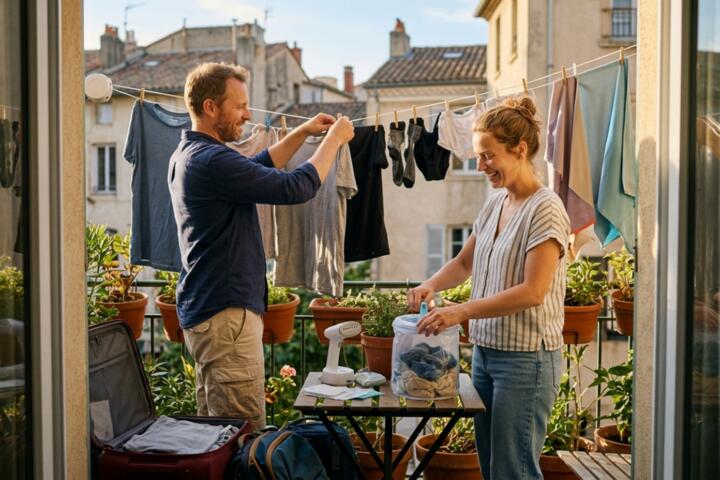
Rethinking Mobile Laundry Management
For the digital nomad or the month-long expat, laundry isn't a chore; it's a logistical pillar. When you are living out of a 40-liter carry-on for eight weeks, you effectively have a three-to-five-day rotation of clothing. This creates a high-frequency washing cycle that standard hotel infrastructure—often consisting of a single, poorly ventilated bathroom—cannot support.
In practice, relying on hotel dry cleaning can cost upwards of $5–$10 per shirt, while local "wash and fold" services in hubs like Lisbon or Bangkok may take 24–48 hours to return your items. A professional traveler uses a "micro-load" strategy: washing 2–3 items every evening. This ensures that even in humid climates like Bali, clothes have a full 24-hour window to dry before they are needed again.
Statistics from travel logistics studies suggest that travelers who manage their own laundry reduce their luggage weight by approximately 35%. This isn't just about convenience; it’s about avoiding checked bag fees, which averaged $30–$50 per flight in 2024, potentially saving a frequent flyer over $500 annually.
Common Pitfalls in Extended Stay Fabric Care
The most frequent mistake travelers make is the "Bathroom Radiator Trap." Hanging damp cotton t-shirts over a lukewarm hotel radiator often results in a "sour" smell caused by slow bacterial growth in the fibers. Without proper airflow, a heavy garment can take over 18 hours to dry, missing the window for your next departure.
Another critical error is the misuse of hotel sinks. Most sinks are not designed for agitation, and using standard hotel bar soap leaves a waxy residue that attracts more dirt over time. This leads to "graying" of white fabrics and a stiff texture that irritates the skin during long walks.
Finally, many rely on suction-cup clotheslines that inevitably fail at 3:00 AM. When a line collapses, clean clothes fall onto potentially unsanitary bathroom floors, necessitating a complete re-wash. These minor failures aggregate into a significant "time tax" on your travel experience, causing unnecessary stress during what should be a seamless journey.
Professional Solutions for On-the-Go Maintenance
The Architecture of the Bungee-Style Clothesline
A high-quality travel clothesline should be "pegless." Models like the Sea to Summit Lite Line use a dual-cord design with beads that slide to secure fabric. This eliminates the need to carry separate clothespins, which are bulky and easily lost.
To maximize efficiency, anchor your line in a "cross-draft" position. Positioning the line between a window latch and a door hinge allows moving air to strip moisture from the fabric. In a 20°C room with 50% humidity, a synthetic tech-tee will dry in under 4 hours on a pegless line, compared to 9 hours if draped over a chair.
Ultrasonic Cleaning and Scrub Bags
The Scrubba Wash Bag has changed the game for long-term stays. It features an internal flexible washboard. By adding just 3 liters of water and a dash of biodegradable detergent like Dr. Bronner’s Pure-Castile Soap, you can achieve a machine-quality wash in 3 minutes.
This method is 2x more effective than sink washing because it uses pressurized agitation. For delicate electronics or high-end fabrics, the Sonic Soak—an ultrasonic tool—uses 50,000 ultrasonic vibrations per second to microscopic level clean. It’s particularly effective for removing invisible sweat salts from technical apparel like Patagonia or Arc'teryx layers.
Chemical Solutions and Fabric Refreshers
Hard water is a silent enemy in many regions, particularly in Southern Europe and Mexico. Carrying a small 100ml bottle of Soak Wash (a no-rinse formula) prevents mineral buildup in your clothes. No-rinse formulas save approximately 10–15 liters of water per wash cycle, making them an eco-friendly choice for drought-prone destinations.
For items that don't need a full wash, a travel-sized Febreze or a DIY vodka-and-water spray (standard industry practice in theater costuming) can neutralize odors. This extends the "wear-life" of a garment by 40%, reducing the total number of washes required during a 90-day trip.
Portable Dehumidifiers and Drying Boosters
In tropical environments where humidity exceeds 80%, clothes will never air-dry naturally. Expert travelers carry a "drying bag" or use the "Towel Roll Method" with a high-absorbency microfiber towel like those from Nomadix.
By rolling a wet garment inside a dry microfiber towel and standing on it, you remove 70% of the moisture before hanging it up. This mechanical extraction is the difference between a shirt being dry by morning or remaining damp and unusable.
Global Voltage and Compact Steamers
Traditional irons in budget accommodations are often calcified and can ruin expensive merino wool. A dual-voltage travel steamer, such as the Nurture Steam, is essential for business travelers. It operates on both 110V and 220V systems, ensuring you can remove packing creases in London or New York without a transformer. Steam also kills 99% of bacteria, acting as a secondary sanitization layer for "multi-wear" items.
Implementation Cases
Case Study: The 90-Day Digital Nomad in SE Asia
A software developer spent three months traveling through Vietnam and Thailand with only a 35L backpack. Initially, he spent $15 a week on laundry services, but the aggressive industrial machines destroyed two of his merino wool shirts (valued at $160).
By switching to a Scrubba Bag and a Sea to Summit line, he reduced his weekly laundry cost to $1 (the price of detergent). More importantly, his clothes lasted the entire duration of the trip without pilling or shrinking. He saved an estimated $180 in service fees and $160 in garment replacement costs.
Case Study: The Corporate Road Warrior
A consultant on a 4-week multi-city tour of Europe used the "Towel Roll Method" combined with a compact Travel Smart by Conair steamer. By washing her base layers in the sink every two nights and steaming her blazers, she avoided checking a 50lb suitcase.
The result was a total time saving of approximately 6 hours typically spent at luggage carousels and an estimated $120 saving in airline "heavy bag" surcharges. Her "per-item" cost for maintenance dropped from $8 (hotel pricing) to roughly $0.20.
Comparison of Laundry Drying Strategies
| Strategy | Drying Time (Synthetic) | Effort Level | Space Required | Best For |
|---|---|---|---|---|
| Hotel Hanger | 8–12 Hours | Low | Minimal | Single night stays |
| Pegless Bungee Line | 4–6 Hours | Medium | Small Pouch | Multi-night stays |
| Towel Roll + Line | 2–3 Hours | High | Microfiber Towel | Humid climates |
| Portable Travel Dryer | 45 Minutes | High | Large (1lb+) | Emergency situations |
| Ultrasonic + Line | 4–5 Hours | Medium | Tech Device | Deep cleaning |
Mistakes to Avoid During Long Stays
One of the most destructive habits is using too much detergent. In a portable wash bag or sink, you only need about a teaspoon (5ml) of concentrated liquid. Excess soap is incredibly difficult to rinse out by hand. Residual soap stays in the fibers, attracting dirt faster and potentially causing "backpacker's rash" (contact dermatitis) when you sweat.
Do not hang heavy sweaters or knits by the shoulders on a thin clothesline. The weight of the water will permanently deform the garment, creating "popeye shoulders." Instead, lay heavy items flat across the top of the line or on a clean towel.
Avoid using "suction cup" lines on porous surfaces like painted drywall or textured tile. They only work on glass or polished marble. Always look for a line with "universal hooks" or "cinch loops" that can wrap around towel racks, door handles, or even balcony Railings.
Frequently Asked Questions
Can I take a travel steamer in my carry-on luggage?
Yes, travel steamers are permitted in carry-on bags. However, ensure the water reservoir is completely empty before passing through security to comply with liquid restrictions.
What is the best detergent for hand-washing technical fabrics?
Look for "sport wash" or pH-neutral detergents like Nikwax or Granger's. These preserve the DWR (Durable Water Repellent) coatings on jackets and the wicking properties of gym gear.
How do I dry clothes in a room with no windows?
Turn on the bathroom exhaust fan and hang your line as close to it as possible. Alternatively, use the hotel's desk fan to create artificial airflow directly onto the dampest parts of the clothing (underarms and waistbands).
Are ultrasonic cleaners actually effective?
They are highly effective for "invisible" dirt like oils and salts. However, they do not "scrub" away physical stains like mud or ink. For those, a manual scrub bag or brush is still required.
How do I prevent my clothesline from sagging?
Use a "trucker's hitch" knot if using a simple cord, or choose a bungee-style line that is 20% shorter than the distance you need to span. The tension is what keeps your clothes off the floor.
Author’s Insight
In my fifteen years of traveling across six continents, the single most important "gadget" I carry isn't electronic—it’s a simple 2-meter length of 2mm paracord and two Nite Ize Figure 9 carabiners. This setup allows me to create a high-tension drying line anywhere, from a sleeper train in India to a high-end hotel in Tokyo. My biggest piece of advice: always do your laundry the moment you check in, not the night before you check out. That extra "buffer time" is the secret to never packing a damp sock.
Conclusion
Successfully managing laundry during long stays is a blend of the right hardware and disciplined habits. Investing in a pegless clothesline, a dedicated wash bag, and a high-quality microfiber towel transforms a chaotic chore into a streamlined 10-minute routine. By prioritizing airflow, mechanical water extraction, and proper detergent usage, you can maintain a professional appearance while enjoying the freedom of a lighter bag. Stop paying hotel laundry premiums and take control of your travel wardrobe today.