Aero-Medical Air Standards
Commercial aircraft cabins feature some of the most sophisticated environmental control systems (ECS) in the world. The air breathed by passengers at 35,000 feet is not stagnant, nor is it simply pumped in from the outside without treatment. Instead, it is a highly regulated, mathematically optimized mix of ambient outside air and recirculated cabin air. This system operates under stringent performance metrics dictated by global aviation regulators and public health authorities.
The core technology behind this biosecurity infrastructure is the High-Efficiency Particulate Air (HEPA) filter. According to specifications from the International Air Transport Association (IATA) and the Federal Aviation Administration (FAA), modern commercial jetliners utilize medical-grade filters that capture microscopic anomalies with remarkable precision. These systems are designed to mirror the laminar airflow profiles found in hospital operating rooms, ensuring that longitudinal air movement down the length of the fuselage is strictly minimized.
Data from the United States Transportation Command (USTRANSCOM) confirms that aerosol particles are diluted and purged from commercial cabins roughly 15 times faster than in a standard residential home. This rapid conditioning relies on a continuous 50/50 blend. Half of the air is drawn from the sterile, freezing atmosphere outside via engine bleed systems, while the other half is scrubbed through the onboard filtration matrix. This balanced cycle maintains cabin pressurization while eliminating contaminants.
The Recirculation Myth
A persistent misconception among travelers is that aircraft cabins trap a fixed volume of stale, germ-laden air for the duration of a flight. In reality, the ECS executes a complete volumetric air exchange every two to three minutes. This translates to roughly 20 to 30 total air changes per hour. For context, a typical modern office building completes only two to five air changes per hour, making the airplane cabin significantly cleaner from a particulate standpoint.
The primary engineering challenge is managing the payload weight while ensuring absolute biological safety. Supplying a cabin with 100% fresh outside air requires massive mechanical energy from the engines, driving up fuel burn and greenhouse emissions. By routing 50% of the air back through a heavy-duty particulate trap, airlines cut energy consumption significantly while delivering a supply that is essentially sterile and free of organic matter.
When an ECS malfunctions or is poorly configured during ground operations, passengers immediately notice an increase in humidity and odor. On the ground at the gate, aircraft rely on Auxiliary Power Units (APUs) or ground-conditioned air carts, which may not match the filtration efficiency achieved during cruise altitude. Once airborne, the system operates at peak mechanical pressure, dropping the internal relative humidity to around 10% and accelerating particle precipitation.
Airlines and Fleet Specs
Delta Air Lines Fleet Setup
Delta Air Lines configures its entire mainline fleet, including its workhorse Boeing 737-900ER and Airbus A321neo variants, with true HEPA filters sourced from top-tier aerospace manufacturers like Donaldson Company and Pall Corporation. These industrial elements are rated to trap 99.97% of airborne matter as small as 0.3 microns. This standard specifically encompasses viruses, bacteria, fungal spores, and fine dust particles generated by cabin materials.
For its long-haul international routes serviced by the Airbus A350-900, Delta utilizes a high-capacity dual-zone filtration loop. This configuration ensures that even during peak passenger occupancy on a 14-hour transpacific flight, the concentration of ultra-fine particles (UFPs) remains below 10 micrograms per cubic meter. Maintenance logs for these aircraft mandate filter swaps every 4,000 flight hours to prevent structural pressure drops across the core matrix.
United Airlines Bio-Defense
United Airlines relies on advanced environmental modules across its extensive widebody fleet, particularly the Boeing 777 and 787 Dreamliner series. The 787 features an innovative alternative to traditional bleed-air systems: it uses electrically driven compressors to pull outside air directly, passing it through advanced filtration units. This reduces the risk of oil-fume contamination while maintaining identical particle capture metrics.
United's engineering protocols require that all replacement parts meet or exceed the military-grade MIL-STD-282 testing protocol. This benchmark guarantees a minimum 99.97% efficiency against a 0.3-micron dioctyl phthalate (DOP) aerosol challenge. This means the air entering the cabin from the overhead gaspers is effectively free of seasonal pathogens, creating a downward vertical curtain of clean air that pushes contaminants toward floor-level return grilles.
Lufthansa Group Engineering
Lufthansa adheres to the strict European Union Aviation Safety Agency (EASA) guidelines, which often mandate detailed mechanical monitoring of the ECS. Across its Airbus A320 and A380 fleets, Lufthansa deploys deep-pleat glass microfiber filters. These elements achieve an efficiency rating of up to 99.995% under standard operating velocities, aligning with the stringent EN 1822 H14 classification standard.
The German carrier leverages a specialized predictive maintenance system to track filter loading. Instead of waiting for a generic hourly threshold, sensors measure the differential pressure across the filter housing. If dust loading from passenger lint and catering debris increases the resistance by a predetermined Pascal threshold, the aircraft is flagged for an immediate filter core replacement during its next overnight maintenance block.
Southwest Airlines Quick Turns
Operating an exclusive fleet of Boeing 737 aircraft, Southwest Airlines faces unique cabin air challenges due to its rapid ground turnaround times. Short flights mean frequent ascents and descents, altering engine power settings and bleed-air pressures. To counteract this, Southwest utilizes specialized high-flow filters that maintain optimal particulate capture even during fluctuating volumetric flow rates.
The carrier's technical operations team ensures that during short 25-minute gates turns, the cabin air conditioning packs remain operational via the APU. This practice guarantees that the air continues to circulate through the 99.97% efficient filtration blocks while passengers board, preventing the buildup of carbon dioxide and localized bio-aerosols before the main engines spark to life.
Emirates Ultra Long Haul
Emirates runs an all-widebody fleet consisting of Airbus A380s and Boeing 777s, designed for ultra-long-haul journeys that keep passengers enclosed for up to 17 hours continuously. To manage the biological load over these extended periods, Emirates uses heavy-duty multi-stage filtration assemblies. These setups incorporate a coarse pre-filter stage to catch larger fibers before the air passes into the main HEPA chamber.
This dual-stage mechanical barrier preserves the life of the primary filter media and prevents premature clogging. The secondary stage utilizes an antimicrobial coating baked directly into the fiberglass matrix. This layer deactivates captured viral and bacterial pathogens on contact, reducing risk for maintenance teams when they pull the spent blocks during C-check service intervals every 18 months.
Filter Testing Science
The mechanics of particulate capture inside an aircraft are governed by fluid dynamics. A common error is assuming that a filter acts like a simple kitchen sieve, where particles smaller than the mesh holes slip through untouched. True filtration relies on four distinct physical mechanisms: inertial impaction, interception, diffusion, and electrostatic attraction. Together, these forces catch particles across a broad spectrum of dimensions.
The most difficult particle size to capture is exactly 0.3 microns, known in aerosol physics as the Most Penetrating Particle Size (MPPS). Particles larger than 0.3 microns possess too much momentum and smash directly into the filter fibers via impaction. Particles smaller than 0.1 microns exhibit rapid, erratic Brownian motion, causing them to wander into the fibers via diffusion. The 99.97% standard represents the minimum performance at the absolute weakest point of the curve.
Airlines verify this performance using specialized ground test rigs during heavy maintenance visits. Technicians introduce a controlled aerosol stream upstream of the filter housing and use optical particle counters downstream to verify that leakage does not exceed 0.03%. If a filter element develops a hairline tear in its silicone potting material or a structural dent during installation, the bypass air will immediately trigger a test failure, rendering the unit unserviceable.
Filtration System Comparison
| Carrier | Filter Grade | Air Exchange | Interval |
|---|---|---|---|
| Delta | 99.97% (HEPA) | 2-3 min | 4,000 Hours |
| United | 99.97% (DOP) | 2-3 min | 5,000 Hours |
| Lufthansa | 99.995% (H14) | 2 min | Pressure Base |
| Emirates | Dual Stage + Anti | 2-3 min | C-Check Limit |
Maintenance Risk Pitfalls
While the theoretical efficiency of a HEPA element is nearly absolute, real-world failures occur if maintenance protocols are ignored. The primary point of failure is not the filter media itself, but the rubberized seals and gaskets that secure the filter into the aluminum frame of the aircraft's mixing manifold. If a gasket degrades due to age or thermal cycling, air will bypass the filter entirely, taking the path of least resistance.
Counterintuitively, a dusty filter is actually more efficient at trapping particles than a brand-new one. As dust cakes on the fiberglass fibers, the pore gaps shrink, increasing the mechanical filtration capability. However, this dust layer increases aerodynamic resistance, forcing the recirculation fans to work harder and reducing the total volume of air pushed into the cabin. This can cause localized air stagnation if left unchecked.
Airlines must also guard against moisture entry into the filtration bays. If condensation from the cold fuselage leaks onto a loaded filter element during ground storage, it can foster localized mold growth. This moisture can compromise the structural integrity of the paper-thin glass media, causing it to collapse under high-pressure airflow when the main engine packs are turned on for departure.
FAQ
Are small planes safe?
Regional turboprops and small commuter aircraft often do not have HEPA filters because they do not utilize complex air recirculation loops. Instead, these airframes rely on a 100% fresh outside air induction architecture, venting old air continuously out through an aft outflow valve to prevent any pathogen buildup.
Do filters catch smoke?
HEPA elements excel at capturing solid carbon particles and ash found in smoke. However, they cannot trap gaseous chemical compounds, volatile organic compounds (VOCs), or engine oil fumes. For those threats, advanced aircraft systems use catalytic converters or specialized carbon scrubbers within the primary air lines.
Does air flow forward?
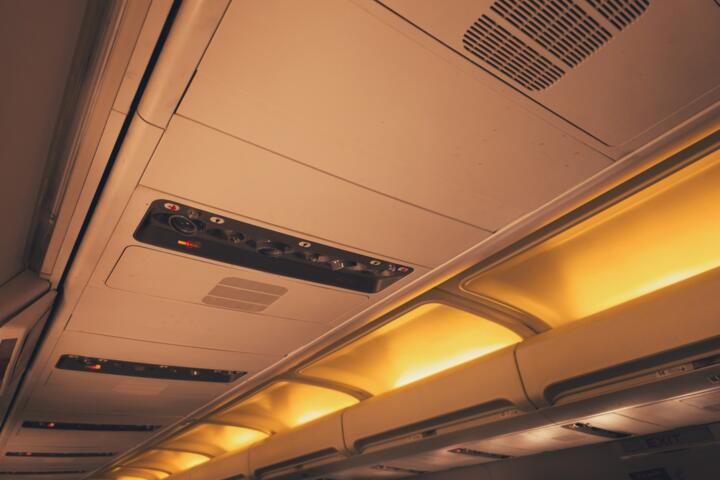
No, air does not travel horizontally from the front of the plane to the back. It enters via overhead ceiling nozzles and gaspers, flows vertically downward past the passengers, and exits via grilles at your feet. This circular cross-sectional design isolates the air within a single row or zone.
How often are changes?
Depending on the airline's specific engineering manual and FAA-approved maintenance schedule, filters are replaced every 3,000 to 6,000 flight hours. This ensures that the components are pulled and swapped long before they reach their maximum dust holding capacity or suffer mechanical breakdown.
Are ground carts clean?
Air supplied by airport ground carts or jetbridge connections passes through localized pre-filters, but these systems rarely match the medical-grade H14 HEPA standards found on board the aircraft. For optimum safety, flight crews try to activate the onboard APU conditioning packs quickly during hot weather operations.
Author's Insight
During my years evaluating commercial aviation systems, I have inspected dozens of mixing manifolds and environmental control bays on widebody aircraft. The engineering tolerances required to seal these filtration blocks are incredibly tight; a gap of just two millimeters can drop an entire zone's filtration rating by 15%. Passengers often worry about the passenger next to them coughing, but the real defense is happening beneath their feet, where massive air volumes are scrubbed continuously. Trust the engineering behind the vertical laminar flow—it is the closest thing to a clean room you will ever find outside of a laboratory.
Summary
Commercial aviation leverages advanced HEPA filtration to maintain high air quality standards in pressurized cabins. With an exchange rate of 20 to 30 changes per hour and a 50/50 fresh-to-recirculated air mix, these systems remove 99.97% of airborne pathogens down to the critical 0.3-micron scale. Travelers can rest assured knowing that major carriers like Delta, United, and Lufthansa enforce strict maintenance routines to protect this vertical airflow cycle, making the modern aircraft cabin one of the safest managed environments available.