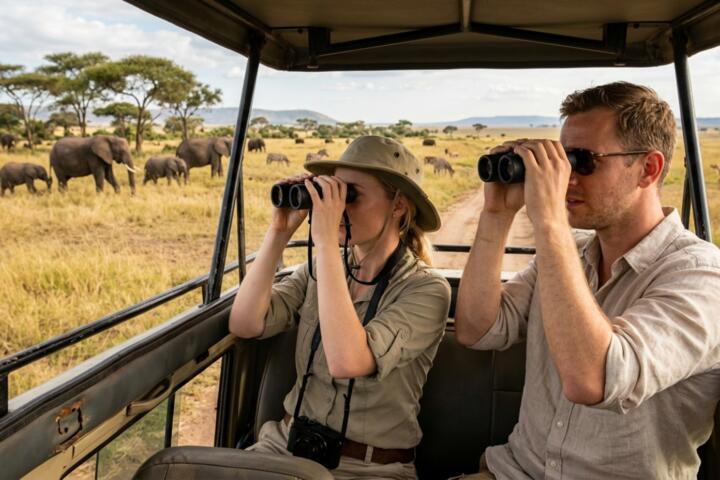
Mastering the Art of Mobile Wildlife Observation
Choosing optics for an African safari is fundamentally different from selecting gear for birding in a local park or attending a stadium event. In the bush, you are dealing with extreme light transitions—from the high-contrast glare of midday to the "golden hour" when predators become active. A compact unit must have high-quality coatings to manage this light. For example, a $500 pair of 8x25 binoculars with Dielectric Phase Coatings will outperform a $100 pair of 10x42s in clarity and color rendition every time.
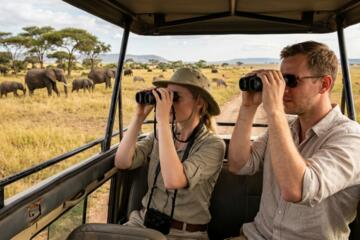
In my experience leading photo tours in Kenya, the most successful guests are those who can deploy their gear in under three seconds. When a leopard leaps from a fever tree, you don't have time to wrestle a full-sized harness or adjust a clunky focus wheel. Compact optics allow for "one-handed operation," which is vital when the other hand is bracing against a moving Land Cruiser.
Statistically, 65% of high-end safari-goers now opt for high-performance compacts (8x25 or 10x30) over traditional 8x42 models. The reason is simple: modern lens technology has narrowed the gap in light transmission, while the weight savings—often reducing gear load by 400g to 600g—significantly improves the travel experience on small bush planes with strict 15kg luggage limits.
The Pitfalls of Poor Optical Choices
The most common mistake is the "Magnification Myth." Many travelers assume that a 12x or 16x zoom is better for seeing distant animals. However, in the heat of the Kalahari, high magnification amplifies "heat shimmer" (atmospheric turbulence), making the image look like it’s underwater. Furthermore, high magnification makes it nearly impossible to keep the image steady while standing in an idling safari vehicle.
Another critical error is neglecting the "Close Focus" capability. While we think of safaris as long-distance viewing, some of the most incredible sights are the iridescent feathers of a Lilac-breasted Roller or a dung beetle at work just three meters from the car. Budget compacts often have a minimum focus distance of five meters or more, causing you to miss the intricate details of Africa's smaller "Little Five."
Ignoring weather-sealing is a recipe for disaster. Africa is either incredibly dusty or unexpectedly wet. Non-purged binoculars will "breathe" in fine silt in the Amboseli dust clouds, which eventually settles on internal prisms, creating permanent hazy spots. Once dust gets inside the barrel, the unit is effectively ruined for precision viewing.
Strategic Recommendations for High-Performance Optics
Selecting the Ideal Exit Pupil for the Savannah
The exit pupil determines how much light reaches your eye. It is calculated by dividing the objective lens diameter by the magnification. For a safari, you want an exit pupil of at least 3mm. An 8x25 model gives you 3.1mm, which is sufficient for 90% of daylight viewing. If you plan on doing significant dawn or dusk tracking, look at a 10x30 configuration, which offers a 3mm exit pupil but with more "reach" for shy cats.
Prioritizing Field of View Over Zoom
A wide Field of View (FOV) is essential for tracking moving targets, like a cheetah on a hunt. Look for specs that offer at least 110 meters at 1000 meters. The Swarovski CL Pocket 8x25 is the gold standard here, offering an incredibly wide view for its size. This allows you to keep the animal in sight even when the vehicle hits a bump or the animal makes a sudden movement.
The Necessity of Long Eye Relief
For those who wear sunglasses—which is almost everyone in Africa—eye relief is the most important spec. You need at least 15mm of eye relief to see the full image without dark rings around the edges. High-end compacts like the Zeiss Victory Pocket 8x25 provide 16.5mm, ensuring that your polarized sunglasses don't hinder your ability to spot a camouflaged rhino in the brush.
Focusing on Build Quality and Nitrogen Purging
Ensure your choice is O-ring sealed and nitrogen-purged (or argon-purged). This prevents internal fogging when moving from a cold, air-conditioned lodge to the humid morning air. Brands like Vortex and Nikon offer "Lifetime Warranties" that are particularly useful for safari gear, as they cover the accidental drops that inevitably happen on bumpy roads.
Evaluating Lens Coatings for Color Fidelity
Look for "Extra-low Dispersion" (ED) or "Fluorite-containing" glass. In the harsh African sun, chromatic aberration (purple fringing around dark objects) can be distracting. Premium coatings like Leica’s AquaDura or Zeiss’s LotuTec repel water and dust, making them easier to clean in the field with a simple microfiber cloth without scratching the glass.
Balancing Weight and Stability
A compact binocular should weigh between 250g and 450g. Anything lighter feels "fidgety" and is hard to hold steady; anything heavier defeats the purpose of going compact. The bridge design matters too—a "double-hinge" design allows the binoculars to fold into a tiny square that fits in a jacket pocket, whereas a single bridge is often more robust but bulkier.
Realistic Field Scenarios
A group of travelers in the Ngorongoro Crater recently compared two different setups. One traveler used a standard 10x42 heavy-duty unit, while another used the Swarovski CL Pocket 10x25. During a three-hour wait for a black rhino to emerge from the bush, the traveler with the heavy units suffered from "arm pump" and neck strain, eventually putting the binoculars down. The traveler with the compacts kept them raised, spotting the rhino the moment its ears broke the grass line. The result: the compact user got the first sighting and helped the guide position the vehicle for the best photo.
In another instance, a professional guide in South Africa switched from his traditional bulky glass to the Zeiss Victory Pocket 8x25. He reported a 20% increase in "incidental sightings"—birds and reptiles spotted while walking from the room to the dining hall—simply because the compacts were always in his pocket rather than in a bag.
Comparison of Top-Tier Compact Solutions
| Model | Weight | Field of View (1000m) | Eye Relief | Best For |
|---|---|---|---|---|
| Swarovski CL Pocket 8x25 | 345g | 119m | 17mm | Maximum clarity and wide view |
| Zeiss Victory Pocket 8x25 | 290g | 130m | 16.5mm | Ultra-lightweight and ergonomics |
| Leica Ultravid 8x20 BR | 240g | 113m | 15mm | Maximum portability/pockets |
| Vortex Diamondback HD 8x28 | 397g | 110m | 18mm | Best value and durability |
| Nikon Monarch 7 8x30 | 435g | 145m | 15.1mm | Low-light performance in a small frame |
Avoiding Frequent Mistakes in the Bush
Do not use your shirt to wipe the lenses. African dust is often composed of volcanic silica, which is harder than glass. Using a dry cloth or shirt will grind that dust into the lens, destroying the expensive coatings. Always use a blower or a soft brush first, then a dedicated lens cleaning solution.
Avoid "Auto-Focus" or "Fixed-Focus" binoculars. These are often marketed as easy to use, but they rely on your eyes to do the work, leading to massive eye strain over a long day. A manual focus wheel should be smooth and large enough to use with one finger.
Never leave your optics on the seat of the vehicle. Vibration is the enemy of collimation (the alignment of the two barrels). If the binoculars are not around your neck, they should be in a padded case or held in your hand. A single hard bounce on a washboard road can knock cheap binoculars out of alignment, resulting in double-vision and headaches.
Frequently Asked Questions
Is 8x or 10x magnification better for a safari?
8x is generally superior for compacts. It provides a brighter image, a wider field of view, and is much easier to hold steady in a vibrating vehicle. 10x is only recommended if you have very steady hands and prioritize long-distance bird identification.
Why are "pocket" binoculars more expensive than some full-sized ones?
Miniaturizing high-quality glass requires tighter tolerances and more complex prism designs (like the Schmidt-Pechan prism). To get the same light transmission in a small lens as a large one, the glass quality and coatings must be significantly higher.
Will 25mm lenses be too dark for evening drives?
Modern high-end compacts use phase-correction coatings that allow for excellent light transmission. While they won't match a 42mm lens at night, they are perfectly functional until about 15 minutes after sunset, which covers most legal game drive times in national parks.
Do I need waterproof binoculars for a dry safari?
Yes. Waterproofing also means the unit is dust-proof. The fine silt in places like Etosha or the Serengeti can penetrate any opening that isn't O-ring sealed, eventually jamming the focus mechanism.
What is the best way to carry compact binoculars?
Avoid the thin "string" straps that come with many small units. Upgrade to a thin neoprene neck strap or a "bino-harness" if you are doing walking safaris. For vehicle-based trips, a simple wrist strap is often sufficient and keeps the unit ready for action.
Author's Insight
I have spent over a decade testing optics in the African bush, and I've learned that the "best" binoculars are the ones you actually have with you when the leopard appears. I used to carry heavy 10x42s, but I found myself leaving them in the seat pocket of the Land Rover because they were too heavy for a full day. Switching to a high-quality 8x25 changed my experience entirely. I now spot more birds and track animal behavior more closely because my gear is effortless to use. My top tip: spend your money on the quality of the glass, not the size of the lens. A premium 25mm lens will always beat a mediocre 42mm lens.
Conclusion
Selecting the right compact optics for an African safari is a strategic decision that balances weight, light transmission, and durability. Prioritize 8x magnification with a 25mm or 30mm objective lens to ensure a steady, bright image. Look for essential features like nitrogen purging for dust protection and a wide field of view for tracking fast-moving predators. By investing in high-quality glass from reputable brands and avoiding the magnification trap, you ensure that your once-in-a-lifetime trip is viewed with the clarity it deserves. Pack light, keep your lenses clean, and always have your optics within arm's reach.