Travel Architecture
A professional travel setup is not a collection of items; it is a modular system where every gram must justify its presence. Think of your gear as "hardware" (the carry system) and "software" (the contents). An effective setup balances the 7-kg carry-on limit often imposed by international carriers with the necessity of maintaining productivity on the road.
In 2024, the travel industry saw a 15% increase in "one-bag" travelers, driven by rising checked bag fees and the desire for agility. Practical experience shows that a 35L to 45L volume is the "sweet spot" for most climates. For instance, a traveler using a 40L Peak Design Travel Backpack can move seamlessly from a Tokyo subway to a Swiss rail platform without the logistical burden of wheeled luggage.
According to SITA, mishandled baggage rates reached 7.6 bags per thousand passengers globally in recent years. By building a carry-on-only setup, you statistically eliminate the primary risk of losing your essential tools and wardrobe during transit.
Common Failpoints
The most frequent error is "just-in-case" packing, which results in a bloated 20-kg suitcase that restricts movement. Travelers often prioritize quantity over versatility, carrying five single-use shirts rather than three high-performance merino wool options. This lack of utility leads to physical fatigue and increased logistics costs.
Cheap equipment is another critical failure point. A budget zipper failing in a remote region of Patagonia or a non-waterproof laptop sleeve during a monsoon in Bali can result in hundreds of dollars in damage. Relying on "disposable" fast-fashion gear creates a cycle of constant replacement that is neither cost-effective nor sustainable.
Inconsistent organization is the final hurdle. Without a dedicated "home" for every cable, SD card, and toiletry item, travelers spend an average of 15–20 minutes daily simply rummaging through bags. This friction accumulates into significant stress over a multi-month journey.
Mastering the Carry System
Your backpack is the chassis of your setup. Invest in a bag with a harness system that transfers weight to your hips. The Osprey Farpoint 40 or the Aer Travel Pack 3 are gold standards because they utilize load lifters and internal frames. A proper fit reduces the perceived weight by up to 30%, protecting your spine during long transit days.
Optimizing the Tech Stack
For digital professionals, the tech kit is the most valuable sub-system. Use a GaN (Gallium Nitride) charger like the Anker 737 to replace three separate power bricks. This single device can power a MacBook Pro, an iPhone, and AirPods simultaneously, saving significant space and weight. Always carry a 10,000mAh PD-enabled power bank for emergency navigation.
Advanced Wardrobe Logic
Adopt a "layering" philosophy rather than a "bulk" philosophy. Three thin layers (a merino tee, a Patagonia Nano Puff, and a Gore-Tex shell) provide more warmth and versatility than one heavy winter coat. This approach allows you to adapt to temperatures ranging from 5°C to 25°C using the exact same kit.
The Modular Packing Method
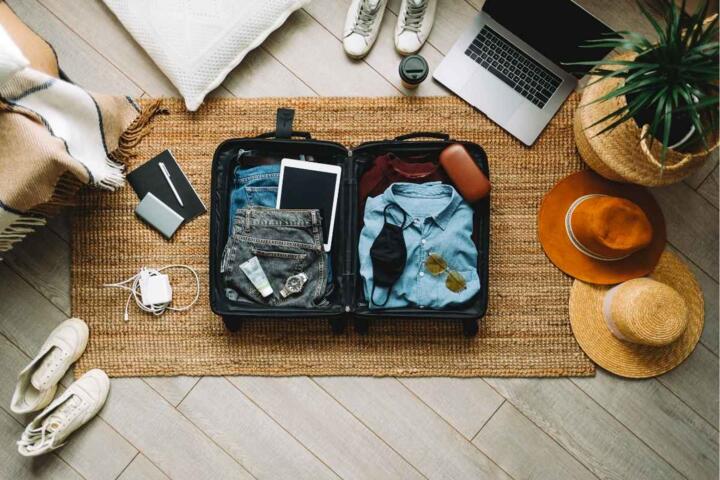
Compression packing cubes, such as those from Peak Design or Eagle Creek, are non-negotiable. They don't just save space; they act as "drawers" for your bag. Categorize cubes by type: one for essentials, one for laundry, and one for tech. This prevents the "explosion" of gear every time you open your bag in a hostel or hotel.
Health and Hygiene Kits
Standardize your toiletries using Matador FlatPak bottles. Unlike rigid plastic, these dry-through technology bags save space as they empty. Limit liquids to the essentials and switch to solid bars for shampoo and cologne to breeze through TSA checkpoints without removing your liquids pouch.
Data and Security Layers
Physical security is paramount. Use a Pacsafe cable lock to secure your bag to fixed objects in transit hubs. Digitally, ensure all devices are backed up to a 2TB SanDisk Extreme Portable SSD and synced to a cloud service like Google Drive or Backblaze before departure.
Footwear Consolidation
Shoes are the heaviest, bulkiest items. Limit yourself to two pairs: one "active" pair worn during transit (like Vivobarefoot or Hoka) and one "aesthetic" pair packed flat (like Allbirds or high-quality leather Chelsea boots). This 1+1 strategy covers 95% of social and physical scenarios.
Real-World Deployment
Case Study 1: The Six-Month Nomad. A freelance designer transitioned from a 23-kg checked suitcase to a 40L Aer Travel Pack. By switching to a capsule wardrobe of 7 items and a specialized tech pouch, they reduced packing time from 45 minutes to 8 minutes. Result: $450 saved in baggage fees and zero lost items over 12 borders.
Case Study 2: The Business Trekker. A consultant needed to balance formal meetings with weekend hiking. They utilized a GORUCK GR2 (34L) which fits under most airline seats. By using a "boundary-less" dress shoe and a technical blazer from Ministry of Supply, they maintained a professional appearance while carrying only 8.2 kg of total gear.
Gear Matrix
| Component | Entry-Level | Professional | Primary Benefit |
|---|---|---|---|
| Carry System | Osprey Farpoint | GoRuck / Peak | Durability |
| Organization | Amazon Basics | Peak Design | Space Savings |
| Power Supply | Standard Bricks | Anker GaN | Fast Multi-Charge |
| Apparel | Uniqlo Airism | Western Rise | Odor Resistance |
Avoiding Packing Errors
Never pack "specialized" gear for a one-time event. If you are attending one wedding in a year of travel, rent a suit locally rather than carrying it for 11 months. This "rental-first" mindset keeps your kit lean.
Don't ignore the "Weight Distribution" rule. Heavy items (laptop, power banks) should be placed as close to your back as possible, centered between your shoulder blades. Placing heavy items at the bottom or the outer edge of the bag creates a leverage effect that strains the shoulders.
Avoid cotton at all costs. Cotton is heavy, takes 24 hours to air dry, and retains odors. Synthetic blends or merino wool can be washed in a sink and dried overnight, allowing you to carry 60% less clothing overall.
FAQ
Is a 40L bag enough for a winter trip?
Yes, provided you use high-fill power down insulation (800+ fill) and merino base layers. These items compress significantly, allowing you to maintain a small footprint even in sub-zero temperatures.
How do I handle laundry on long trips?
The "Sink Wash" method is most efficient. Use a Scrubba Wash Bag or sink stoppers with Dr. Bronner’s soap. Most high-performance gear requires only 10 minutes of effort to clean and dries by morning.
What is the most important item to spend money on?
The footwear. A gear failure in your backpack is annoying; a "failure" in your footwear (blisters, lack of support) can physically stop your trip. Invest in proven brands like Salomon or Lowa.
Do I really need a dedicated laptop sleeve?
Yes, even if your bag has a laptop compartment. A secondary sleeve provides "false bottom" protection against drops and allows you to carry just your tech to a cafe without taking your full backpack.
How do I stay under the 7kg limit?
Wear your heaviest items (boots, jacket, camera around the neck) during the weigh-in. Use a lightweight bag (under 1.5kg empty) to maximize your remaining allowance for actual gear.
Author’s Insight
After a decade of traversing 50+ countries with nothing but a 35L pack, I’ve learned that gear is a psychological safety net. We overpack because we fear the unknown. However, the most "expert" move you can make is realizing that you can buy almost anything you truly need in a local pharmacy or market. My best advice: build your kit, then remove three items you think you "might" need. Your back will thank you on that third flight of stairs in a Parisian walk-up.
Summary
Building a complete travel setup requires shifting from a consumer mindset to a curator mindset. By investing in a high-quality carry system, a GaN-based power ecosystem, and a merino-heavy wardrobe, you gain the freedom to move without friction. Focus on the "1+1" footwear rule and modular organization to ensure your gear supports your journey rather than defining it. Start with the core essentials and refine your kit based on real-world usage data from your first two-week trip.