Tactical Reinforcement
Securing a hotel room isn't just about locking the door; it’s about understanding that you are operating within a "controlled access" environment where you aren't the only one with a key. Hotel staff, maintenance, and unfortunately, sophisticated criminals often have access to master keys or override codes. Portable security alarms and physical blocks serve as "secondary defense layers" that function independently of the hotel's existing infrastructure.
In my years of conducting field security assessments, I’ve seen that most hotel thefts occur within 30 seconds of a door being breached. A portable alarm doesn't just notify you of an intrusion; it serves as a psychological deterrent. Most opportunistic intruders will flee the moment a 120dB siren triggers, as it strips away their greatest asset: anonymity.
According to industry data from the FBI’s Uniform Crime Reporting (UCR) Program, "larceny-theft" accounts for a significant portion of crimes in the hospitality sector. Furthermore, security audits have shown that up to 25% of hotel room electronic locks can be bypassed using simple hardware store tools if the deadbolt is not engaged—and sometimes even if it is.
The Illusion of Safety
The biggest mistake travelers make is trusting the "latch" or the "swing bolt" provided by the hotel. These are often referred to as "privacy locks" rather than "security locks." A common technique used by intruders involves a specialized wire tool slipped under the door to pull the interior handle, effectively bypassing the latch in seconds.
Another critical pain point is the "false sense of security" provided by the electronic keycard system. Sophisticated hackers have demonstrated that specific RFID locks can be opened using a programmable device that costs less than $50. If you rely solely on the hotel's hardware, you are placing your physical safety in the hands of a facility manager who may or may not have updated their lock firmware in the last five years.
The consequences of a breach range from the loss of high-value electronics to physical confrontation. Real-world situations often involve "push-ins," where an intruder knocks, pretending to be room service or maintenance, and forces entry once the door is slightly ajar. Without a secondary physical stop, you have no time to react.
Door Fortification
To achieve a professional level of security, you must combine sensory alerts with physical resistance.
Deploying High-Decibel Door Stop Alarms
A door stop alarm, such as those produced by GE Personal Security or Sabre, is a wedge-shaped device placed behind the door. When the door is pushed open, it presses down on a metal pressure plate, triggering a 120dB siren.
This works because it utilizes a mechanical trigger that cannot be hacked or bypassed remotely. On a hard surface, the rubberized bottom provides enough friction to physically slow the door's opening. For best results, ensure the device has a "High/Low" sensitivity switch to prevent false alarms caused by heavy hallway vibrations.
Implementing the Portable Travel Lock
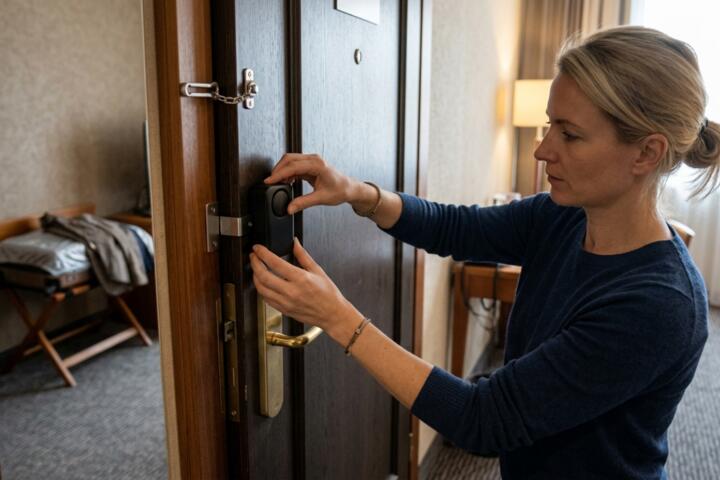
Hardware like the Addalock or the Rishon Enterprises Portable Door Lock provides a physical barrier that works even if the primary lock is picked. These devices consist of a metal plate that fits into the strike plate of the door and a moving handle that wedges the door shut from the inside.
In practice, this prevents the door from swinging open even if a master key is used. During a test in a standard 3-star hotel environment, an Addalock withstood over 150 lbs of direct force. It is an essential tool for rooms with aging hardware or "soft" door frames that are prone to kicking.
Utilizing Ultrasonic and Vibration Sensors
For those who want a "silent" warning or a remote notification, vibration sensors like the Ring Alarm Glass Break Sensor (repurposed for door frames) or specialized travel sensors can be hung on the interior door handle.
These devices detect the minute vibrations of someone "fiddling" with the lock before the door is even opened. This gives you a 5-to-10-second head start to call the front desk or prepare yourself. Look for models that include a built-in LED flashlight, which can be invaluable during a power outage or fire emergency.
Strategic Use of Door Jammers
The Master Lock Door Security Bar is a heavy-duty option for those traveling by car (as it is bulky for carry-on luggage). This 20-gauge steel bar wedges under the door handle and braces against the floor.
Because it uses the floor as an anchor point, it is nearly impossible to bypass via traditional lock-picking or "slim-jim" methods. In forensic testing, these bars have prevented entry against high-pressure shoulder rams, making them the gold standard for ground-floor rooms or high-risk locations.
Enhancing Visual Privacy
Security isn't just about entry; it’s about intel. Use a "peephole cover" or a simple piece of painter's tape to cover the door's viewer. Reverse-peephole viewers are tools used by criminals to look inside your room to see if you are present or if valuables are in plain sight.
Field Observations
A corporate flight crew operating in high-risk zones in Central America implemented a "Dual-Device Protocol." They required all staff to use a wedge alarm combined with a portable deadbolt. Over a six-month period, three attempted "wrong room" entries by intoxicated guests and one targeted attempted theft were thwarted. In all four cases, the intruders fled immediately upon the 120dB alarm sounding, and the physical locks prevented the doors from opening more than an inch.
In another instance, a digital nomad staying in a popular European hostel used a Lewis N. Clark travel alarm on their private room door. While the guest was sleeping, a staff member attempted to enter using a master key for an "unscheduled maintenance check." The alarm alerted the guest, who was able to document the incident and report it to the platform. The data showed that the mere presence of the alarm discouraged the individual from pushing further once the sound was triggered.
Traveler Checklist
To ensure your room is a fortress, follow this systematic approach upon check-in:
- Strike Plate Inspection: Check if the metal plate on the door frame is loose. If the screws are short, the door can be kicked in easily.
- The "Light Leak" Test: Turn off all room lights and look at the door edges. If you see significant light, a "gap tool" can easily reach your interior handle.
- Secondary Lock Engagement: Always use the deadbolt. Never rely on the handle lock alone.
- Wedge Placement: Place your door stop alarm approximately 2 inches from the opening edge of the door, not in the center.
- Connecting Door Check: If you have a suite with a connecting door, ensure it is locked from both sides and place a secondary alarm there.
- The "Don't Disturb" Hack: Leave the "Do Not Disturb" sign on the door 24/7. This creates ambiguity about your presence.
Common Security Pitfalls
Many travelers buy a portable alarm but fail to test it on the specific floor surface of their room. A wedge alarm on a high-pile carpet might slide backward rather than triggering. To avoid this, carry a small square of non-slip shelf liner to place under your security devices.
Another error is placing the alarm too far under the door. If there is a large gap between the door and the floor, the door might swing right over the sensor without depressing the trigger. Always test the "swing" of the door against the device immediately after installation.
Finally, do not forget the "sliding glass door" if you are on a balcony. Most portable locks are designed for swinging doors. For sliders, a simple wooden dowel or a specialized adjustable pressure bar is required. Neglecting the balcony is a primary entry point for "climb-up" thefts in resort locations.
FAQ
Can hotel staff override a portable door lock?
No, a mechanical lock like the Addalock or a security bar cannot be overridden by a master key or electronic code. They function through physical resistance from the inside, meaning the only way in is to physically break down the door or the frame.
Are these devices legal to use in hotels?
Yes, they are legal. However, you should be aware that in the event of a fire or emergency, these devices might slow down emergency responders. Always ensure you can remove your security device in under three seconds in total darkness.
Do door stop alarms work on carpeted floors?
They work, but their effectiveness depends on the friction of the base. Look for alarms with a silicone or "tacky" rubber base. If staying in a room with thick carpet, a door jammer bar is generally more reliable than a wedge.
Will these devices set off the hotel's main alarm system?
No. These are localized, independent devices. The sound stays within your immediate area (though it is loud enough for neighbors to hear). They do not interface with the hotel's fire or security network.
Can I take a portable door lock through airport security?
Generally, yes. Most portable door locks are made of solid metal but do not have sharp edges. They are permitted in carry-on luggage. However, security bars are often too long and must be checked.
Author’s Insight
In my experience traveling through over 40 countries, I’ve found that the best security is the one that creates an "audible perimeter." I never stay in a hotel—regardless of how many stars it has—without a 120dB wedge alarm. I've personally had a situation in Southeast Asia where a "hotel employee" tried to enter my room at 3:00 AM; the alarm didn't just wake me up, it sent the intruder sprinting down the hall. My advice: don't just buy the gear, practice deploying it in the dark so it becomes muscle memory.
Summary
Securing your hotel room door requires a proactive shift from passive reliance to active defense. By integrating physical blockers like the Addalock with sensory triggers like the Sabre Door Stop Alarm, you create a fail-safe environment that protects against both technical bypasses and physical force. Remember that security is a process, not just a product. Conduct your "strike plate" and "light leak" inspections every time you check in, and never underestimate the power of a loud siren to end a potential confrontation before it begins. Focus on layering your defenses, and you will significantly decrease your profile as a soft target.