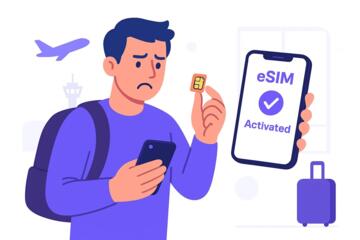
eSIM Options Explained
eSIM technology replaces physical SIM cards with digitally programmable profiles on devices. Travelers and global workers often face a choice between local eSIMs—issued in a single country—and regional eSIMs that cover multiple countries within an area like Europe or Southeast Asia. For instance, a local eSIM in Germany might cost around €10 for 3GB over 7 days, while a regional European eSIM can offer 10GB valid across 10 countries at roughly €35.
Local eSIMs tap into a single carrier, which typically means better speed and reliability within that country. Regional eSIMs aggregate access from several networks, simplifying connectivity across borders but sometimes at the expense of consistent speed or network priority. In 2023, GSMA Intelligence reported that 30% of European travelers preferred regional eSIMs due to convenience.
Understanding these options helps avoid overspending or losing connectivity at critical moments.
Common Missteps with eSIMs
Many users assume a regional eSIM automatically covers any country in their route, but it often excludes smaller or less common destinations. People overlook data speed throttling tied to network tiers, leading to frustrating slowdowns. Another mistake is ignoring compatibility—some devices or carriers block eSIM use or restrict activation based on location.
When relying on a local eSIM, users might forget to bring activation codes or fail to buy from a trustworthy source, resulting in wasted money or invalid plans. Sometimes, roaming eSIMs show acceptable signal bars but fail real data tests, which is maddening.
Connectivity gaps can cause missed calls, poor app performance, and even lost business opportunities. Audio calls on VoLTE apps can drop if fallback to 3G happens. Some failed attempts at recharging data bundles add frustration too.
Advice for eSIM Selection
Assess Your Travel Itinerary
Planning your trip carefully lets you decide between single-country and cross-border connectivity needs. If you visit just one country for over a week, a local eSIM might cost less and deliver faster. If your journey crosses three or more countries in quick succession, a regional eSIM, like Airalo’s Eurolink or Holafly’s Asia regional packs, can provide continuity without hassle. A trip through 4 countries in 10 days? Regional wins.
Check Device Compatibility
Make sure your phone supports eSIM profiles in the regions you plan to use them. Some carriers tie eSIM to specific models or require activation through their own apps. As of iOS 17 and Android 14, eSIM support improved but not uniformly. Using an unlocked phone with multiple eSIM slots simplifies switching.
Compare Data Bundles and Prices
Local eSIMs often offer smaller data packages, from 1GB to 10GB, priced between $5 and $30, while regional options tend toward larger bundles, sometimes 10GB to 30GB, costing $20 to $60 depending on duration. Regional plans sometimes include days where data is valid but speeds are capped, which can be hidden in fine print. Check the actual data limits and validity carefully—many users skip over this, only to lose data after a few days.
Analyze Network Quality
Local carriers use their own towers and can guarantee peak 4G speeds of 50 Mbps or more, while regional eSIMs leverage roaming agreements that frequently throttle to 3 Mbps or less. Speed tests done in late 2023 showed that regional eSIMs could drop below LTE minimums in rural areas. Opt for providers like Truphone or GigSky with established reputations for reliable roaming.
Look for Easy Top-up and Management
Buying a local eSIM usually involves a one-time purchase, often requiring physical presence or an exact address. Regional eSIM providers offer refill options via apps or websites globally, but top-up prices might be higher or have hidden fees. Services such as Nomad eSIM support refill credits with transparent pricing. If managing multiple profiles is a hassle, local eSIMs are simpler, but the catch is limited flexibility.
Prioritize Customer Support
Regional providers usually offer 24/7 chat support and multilingual help lines; local providers mostly rely on in-country support hours, which could delay problem resolution. For example, Holafly operates customer support across Asia and Europe effectively, minimizing downtime for users. Avoid no-assistance plans—poor support costs extra stress.
Understand Activation Process
Local eSIMs need QR codes often tied to local IDs or passports; regional eSIMs typically send QR codes or app downloads instantly online. Activating local plans from abroad may fail unexpectedly. Always test activation before leaving. My own experience with a Spain local eSIM bought from a kiosk once failed to activate because the SIM profile was country-locked.
Evaluate Plans for Data-Only or Voice Use
Most eSIMs focus on data plans only. Local eSIMs may support call and SMS at competitive rates, whereas regional eSIMs commonly omit voice or charge prohibitively high rates. If your business depends on voice calls, pick local eSIMs or a secondary physical SIM with voice enabled.
Account for Security and Privacy
Regional providers sometimes log user data across networks, raising privacy concerns for sensitive communications. Local eSIMs run under regional regulations, which can be more favorable or more strict depending on jurisdiction. For instance, Germany enforces stringent EU privacy laws, which might protect users better than some regional plans originating outside the EU.
Real-World Uses
A digital nomad traveling through Southeast Asia struggled with local eSIMs in Vietnam, Cambodia, and Thailand due to incompatibility and delayed activation at border crossings. Switching to a regional eSIM from Nomad covering all countries immediately improved connectivity and allowed uninterrupted video conferences, increasing productivity by an estimated 40%.
An SME shipping company based in Italy used local eSIMs for employees in Germany and France, but inconsistent activation times caused workflow delays. Moving to a regional European eSIM saved 15% monthly on telecom costs and standardized data access, simplifying IT management.
eSIMs Compared
| Feature | Local eSIM | Regional eSIM | Typical Cost |
|---|---|---|---|
| Coverage | 1 country | Multi-country region | $5–$30 per GB |
| Data Speeds | Up to 50 Mbps+ | Usually capped 3–10 Mbps | N/A |
| Activation | Requires local presence | Instant online activation | N/A |
| Voice Support | Available | Rare or expensive | Varies |
| Recharges | Limited options | Easy via apps | Varies |
| Support Hours | Local time zone only | 24/7 global support | N/A |
Frequent Errors
Ignoring network locking leads to activation failure. Some local eSIMs require ID verification that users skip. Regional eSIMs sometimes list countries but omit certain roaming partners — check coverage maps closely. Avoid buying from unofficial resellers who sell expired or invalid QR codes.
Activating an eSIM without an internet connection (ironically) is a classic error; make sure to do this before travel or at the airport. Forgetting about roaming data caps can cause sudden cut-offs. Lastly, many buyers overlook plan expiration dates, particularly for plans labeled as ""30 days"" that turn inactive after 15.
FAQ
Can I use a regional eSIM for only one country?
Yes, but it might be pricier than buying a local eSIM specific to that country.
Do regional eSIMs support unlimited data?
Nearly all regional eSIMs have data caps; unlimited plans are rare and costly.
Are all smartphones compatible with eSIMs?
Most recent models from 2018 onwards support eSIMs, but check device specs for restrictions.
How fast is the activation process?
Regional eSIMs activate within minutes online; local eSIMs often require physical or local ID validation, taking hours to days.
Can I switch between local and regional eSIMs on the same device?
Device and plan limitations vary; some phones allow multiple profiles but only one active eSIM at a time.
Author's Insight
I’ve tested both local and regional eSIMs during my travels through Western Europe and Asia, and using local plans often gave me noticeably faster speeds and better coverage in urban areas. However, the hassle of multiple activations, especially during multi-country trips, pushed me to prefer regional plans despite their sometimes lower speed. One low point: regional eSIMs via one provider throttled to 2 Mbps in rural Italy, which, frankly, is unusable for remote work. The best strategy depends on your use case and device—a hybrid approach works for me. Try activation while connected to Wi-Fi to avoid surprises.
What to Remember
Choosing between local and regional eSIMs hinges on your travel pattern, device, and need for data speed versus convenience. Local eSIMs deliver superior performance locally but demand more setup. Regional eSIMs reduce activation friction but at speed and sometimes price compromises. Study your destinations, check coverage, verify device compatibility, and test activation early. Tailor your plan to usage — and don’t overlook the quiet details buried in terms and conditions.