The Science of Trail Comfort and Thermal Resistance
In the world of thru-hiking, your sleeping pad is not just a cushion; it is a thermal barrier. While a sleeping bag provides loft to trap warm air above you, the weight of your body crushes that insulation against the ground. Without a pad, the cold earth acts as a heat sink, siphoning warmth via conduction.
Modern lightweight pads utilize two primary technologies to combat this: air-filled chambers with internal reflective baffles and closed-cell foam (CCF). For example, a standard 20-inch wide pad has roughly 1,200 square inches of surface area in contact with your body. If that surface has a low R-value (thermal resistance), you can lose up to 15-20% of your body heat to the ground in sub-freezing temperatures.
I recall a trek in the High Sierras where a client brought a generic "lightweight" air mattress with no internal insulation. Despite a 15°F sleeping bag, they suffered through a night of shivering because the ground temperature was 34°F. Switching to a pad with an R-value of 4.5 the following night completely transformed their recovery, proving that the pad is often more critical than the bag itself.
Critical Failures in Backcountry Sleep Selection
The most common mistake trekkers make is over-prioritizing weight while ignoring the ASTM F3340-18 standard. This is the universal testing method for R-values. Many "budget" brands claim high warmth but haven't been laboratory-tested. When you buy an unrated pad, you are essentially guessing your thermal safety.
Another pain point is the "Narrow Taper" trap. To save a few ounces, manufacturers often aggressively taper pads at the feet. For side sleepers, this leads to knees slipping off the pad onto the cold tent floor. This repeated contact causes "cold spots," which wake the sleeper and interrupt REM cycles, leading to cumulative fatigue on a 10-day trek.
Durability is the final silent killer. A 7-denier (7D) fabric might look great on a scale, but it is prone to punctures from a single stray pine needle or a sharp pebble under your ground cloth. On a multi-day trek, a flat pad is a zero-R-value pad. If you aren't carrying a dedicated repair kit with Tear-Aid Type A patches, a single failure can end your trip.
Engineered Solutions for Weight-Conscious Hikers
Understanding the R-Value Thresholds
For multi-day treks, you need to match your pad to the expected ground temperature, not the air temperature. An R-value of 2.0 to 3.0 is strictly for summer. For three-season use (spring through late fall), you should target 4.0 to 5.5. If you are camping on snow, an R-value of 6.0+ is non-negotiable.
The Role of Fabric Denier and Longevity
Choose your face fabric based on your shelter type. If you use a bivy or a floorless tarp, stick to 30D or 40D nylon (like the Nemo Tensor series). If you use a double-wall tent with a footprint, you can safely drop to 20D (found in the Therm-a-Rest NeoAir XLite NXT). This saves approximately 3-5 ounces without compromising the integrity of the air chamber.
Advanced Inflation Techniques to Prevent Moisture
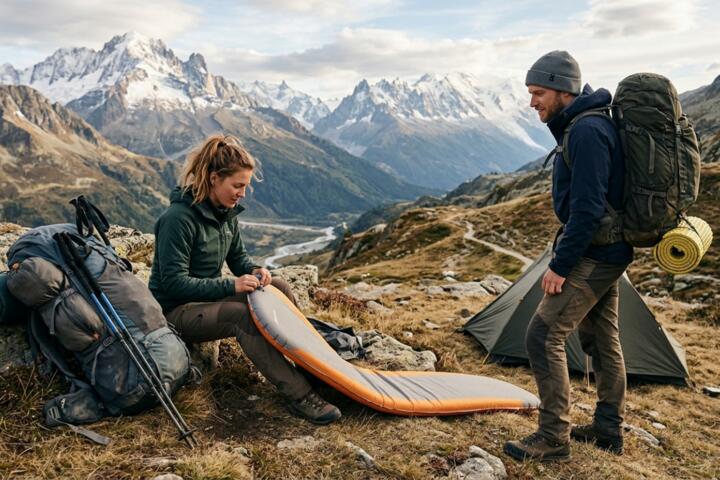
Never blow into your pad with your mouth. The moisture from your breath condenses inside the pad, leading to mold growth and reducing the effectiveness of reflective films. Always use a pump sack. A standard pump sack adds only 1.5 to 2 ounces to your kit but can inflate a large pad in under two minutes while keeping the interior bone-dry.
Body Mapping and Pad Shape Optimization
If you are a restless sleeper, a "Wide" version of a pad is worth the 4-ounce weight penalty. A 25-inch wide pad prevents your arms from falling off the sides, which is the primary cause of mid-night waking. For "gram-counters," consider a torso-length pad combined with your empty backpack under your legs—a classic ultralight move that cuts 6-8 ounces off your base weight.
The Hybrid Insulation Strategy
For extreme durability and safety, many experts use a "stacked" system. Placing a thin 1/8-inch closed-cell foam pad (like the Gossamer Gear Thinlight) underneath an inflatable pad adds roughly 0.5 R-value, protects the inflatable from punctures, and provides a "fail-safe" layer of insulation if the main pad leaks.
Practical Performance Case Studies
Case Study 1: The Appalachian Trail Thru-Hike
A hiker starting in March faced night temperatures of 20°F. They initially used a foam pad (R-value 2.0). After four nights of poor sleep and hip pain, they swapped to a high-loft inflatable with an R-value of 4.2.
- Result: Average sleep duration increased from 5.5 to 7.5 hours. The hiker reported a 15% increase in daily mileage (from 12 to 14 miles) due to improved physical recovery.
Case Study 2: High-Altitude Mountaineering Prep
An expedition team in the North Cascades tested the "stacking" method. They used a Therm-a-Rest Z Lite SOL (R 2.0) underneath a NeoAir XTherm (R 7.3).
- Result: The total R-value of 9.3 allowed for comfortable sleep directly on glacial ice at 10°F. The team saved weight by using lighter sleeping bags because the ground insulation was so efficient.
Comparative Framework for Lightweight Pads
| Feature | Closed-Cell Foam (CCF) | Ultralight Inflatable | Insulated Inflatable |
|---|---|---|---|
| Typical Weight | 10–14 oz | 8–12 oz | 15–22 oz |
| R-Value Range | 1.5 – 2.2 | 2.0 – 3.5 | 4.0 – 7.5 |
| Packed Size | Bulky (External carry) | Size of a soda can | Size of a 1L bottle |
| Durability | Indestructible | Fragile | Moderate |
| Comfort | Minimal (Firm) | High (3–4 inches loft) | High (Cushioned) |
| Best Use | Budget / Desert / Backup | Fast & Light Summer | Four-Season / Comfort |
Avoiding Frequent Maintenance and Selection Errors
One major error is over-inflating the pad. A rock-hard pad is not only uncomfortable but also puts unnecessary stress on the internal baffles and seams. When you lie down, the air pressure increases. The "Expert Method" is to inflate it fully, lie on your side, and slowly release air until your hip is just barely hovering above the ground.
Another mistake is storing the pad rolled up tightly in its stuff sack for months. This can cause the internal laminates to delaminate or the foam to lose its memory. Always store your pad unrolled with the valve open under a bed or in the back of a closet.
Finally, don't ignore the noise. Some ultralight pads use a "crinkly" reflective film that sounds like a potato chip bag. If you are a light sleeper or hiking in a group, this noise can be a dealbreaker. Test the pad in-store by lying on it and rolling around before committing to a long-distance trek.
Frequently Asked Questions
Does altitude affect the pressure in my sleeping pad?
Yes. As you ascend, the atmospheric pressure drops, which can cause an inflated pad to expand. Conversely, when you inflate a pad in the evening and the temperature drops 20 degrees at night, the air inside contracts, making the pad feel "leaky" when it's actually just physics.
Is a self-inflating pad better than a manual inflatable?
Self-inflating pads contain open-cell foam that expands. While they are more puncture-resistant, they are significantly heavier and bulkier than manual inflatables. For multi-day treks, manual inflatables (using a pump sack) offer the best warmth-to-weight ratio.
Can I repair a pad in the rain?
Standard adhesive patches often fail in wet conditions. You should use a permanent TPU patch like Tenacious Tape or a specialized UV-cured adhesive. Always dry the area as much as possible with a pack towel before applying the patch.
What R-value do I need for sleeping on snow?
You should aim for a cumulative R-value of at least 6.0. This is usually achieved by combining a high-insulation air pad with a closed-cell foam pad. Sleeping on snow with an R-value below 4.0 will result in the snow melting under you, creating a literal "ice bath" effect.
Are wide pads worth the extra weight?
For anyone over 180 lbs or those who sleep on their side/stomach, yes. The extra 5 inches of width prevents your limbs from contacting the cold ground, which maintains your core temperature more effectively than a slightly lighter, narrower pad.
Author’s Insight
In over 15 years of backcountry exploration, I’ve found that your sleep system is the one area where you should never "cheap out." I transitioned from a basic foam mat to high-performance inflatables a decade ago, and the difference in my cognitive function on Day 4 of a trek was staggering. My top tip: Always carry a 1-ounce piece of foam to use as a sit-pad during the day; at night, slide it under your hips for an extra boost of insulation where you need it most.
Conclusion
Choosing the right lightweight sleeping pad is a balance of thermal science and personal ergonomics. Prioritize a verified R-value of at least 4.0 for versatility, invest in a wide version if your budget and pack allow, and always use a pump sack to preserve the internal materials. By focusing on these technical details, you ensure that your gear works for you, allowing for the deep recovery necessary to tackle high-mileage days. Invest in your sleep, and the miles will take care of themselves.