Beyond the Screen: Understanding Mobile Survival in High-Velocity Environments
In the world of action sports, a phone isn't just a communication tool; it is a GPS tracker, an altimeter, and often a lifesaver. Standard protective covers are designed for "table-to-floor" drops, typically averaging 1.2 to 1.8 meters. However, a fall from a bouldering wall or a high-speed wipeout on a gravel track subjects the device to G-forces far exceeding standard lab tests.
Real-world physics involves angular momentum and secondary impacts. When a device hits a jagged rock, the force is concentrated on a single point rather than distributed across a flat surface. In 2023, data from specialized electronics insurers suggested that nearly 40% of "rugged" cases failed not because of the initial impact, but due to internal component displacement caused by vibration and shockwaves.
Recent engineering advancements have introduced non-Newtonian fluids and multi-layered polycarbonate shells that mimic crumple zones in vehicles. For instance, high-end protection systems now frequently use materials like D3O, which remains soft at rest but locks together upon impact to dissipate energy.
The Cost of Inadequate Armor: Why Basic Protection Fails
Most athletes make the mistake of prioritizing aesthetics or slimness over mechanical integrity. A common error is relying on "military-grade" labels without checking the specific MIL-STD-810G or 810H parameters. Many cases claim this rating after testing a single drop, which does not account for the repetitive vibration of a handlebar-mounted phone or the fine silt found in desert environments.
The consequences of a failure are rarely just a cracked screen. Internal damage often includes the shearing of ribbon cables or the cracking of the motherboard's solder joints. In backcountry skiing or solo hiking, a dead battery caused by thermal mismanagement—another failure of cheap cases—can lead to a total loss of navigation in sub-zero temperatures.
I have seen riders lose $1,200 devices because a "slim-fit" case popped off mid-tumble. The friction of the slide generates enough heat to melt thin TPU (Thermoplastic Polyurethane), leaving the glass exposed to the asphalt.
Technical Criteria for Maximum Device Integrity
Material Science: The Role of Non-Newtonian Polymers
When selecting a case, look for the integration of D3O or similar dilatant materials. Unlike standard silicone, these polymers react to the rate of shear or strain. In a high-velocity impact, the molecules in these materials jam together, turning the soft sleeve into a rigid shield within milliseconds. This reduces the force transmitted to the phone's internal gyroscopes and optical image stabilization (OIS) systems, which are notoriously fragile in modern camera modules.
Structural Reinforcement and the "Raised Pucker" Design
Impact resistance is largely about the "lay-on-the-table" design, but for extreme sports, the bezel must be at least 2.0mm higher than the screen. This is crucial because, on uneven terrain like a rocky trail, a flat 1.0mm lip will not prevent a protrusion from striking the glass. Brands like OtterBox (specifically the Defender Series) and Pelican utilize a multi-piece assembly where a hard internal frame snaps together before being wrapped in a synthetic rubber slipcover. This creates a suspension system for the phone.
Sealing Standards and Ingress Protection (IP)
For water sports, mud running, or snowboarding, the IP rating is non-negotiable. An IP68 rating means the device is dust-tight and can survive immersion in water. However, a case should augment this. Look for cases with integrated port covers that use mechanical latches rather than friction fits. LifeProof (now part of OtterBox) pioneered the "FRĒ" series, which includes a built-in scratch protector that creates a 360-degree vacuum seal, preventing fine sand and salt crystals from eroding the charging port.
Thermal Regulation for High-Performance Use
Phones generate significant heat when recording 4K video or running GPS in direct sunlight. Many heavy-duty cases act as insulators, causing the CPU to throttle or the battery to shut down. Advanced cases from brands like Nomad or UAG (Urban Armor Gear) now incorporate cooling vents or thermally conductive liners to pull heat away from the glass back of the phone. This is essential for long-distance cyclists who mount their phones on handlebars for hours.
Tactical Mounting and Ecosystem Compatibility
In extreme sports, the best protection is not dropping the phone at all. The move toward magnetic and mechanical mounting "ecosystems" is a game changer. Peak Design and Quad Lock offer cases with built-in locking interfaces. Unlike generic mounts that rely on plastic clamps, these systems use a steel-reinforced locking mechanism. This ensures that even during a "whiskey throttle" or a mountain bike jump, the phone remains physically tethered to the vehicle or person.
Corner Ballistics and Air-Cushion Technology
Data shows that 80% of screen shatters originate from a corner impact. Expert-grade cases utilize "air-cushion" technology, where the corners are hollowed out to create a pocket of air. This acts as a pneumatic spring. Brands like Spigen (Tough Armor line) use this to meet height requirements without adding immense bulk. For extreme climbers, look for cases that include a lanyard loop—a simple but effective $5 feature that prevents a $1,000 drop.
Performance Analysis: Real-World Recovery Metrics
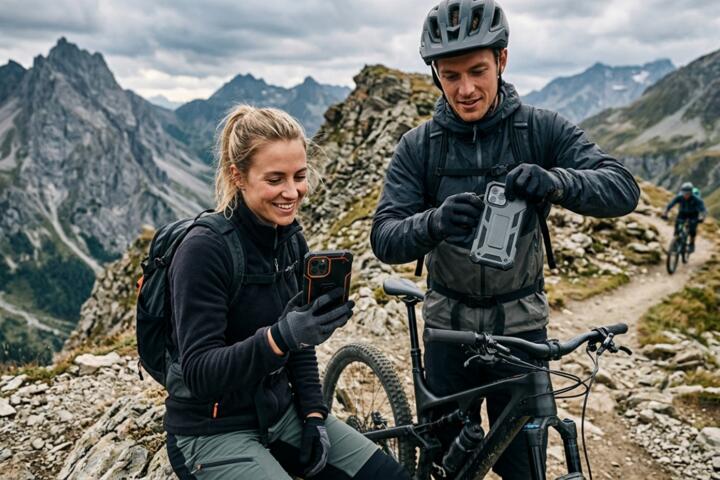
A professional downhill mountain bike team transitioned their support staff and riders from standard "lifestyle" cases to a combination of UAG Monarch Pro and Quad Lock systems. Over a six-month season involving 14 high-altitude competitions, the team reported the following:
- Initial Baseline: 5 shattered screens and 2 total hardware losses due to vibration-induced camera failure in the previous season.
- Action Taken: Implementation of Kevlar-reinforced multi-layer cases and vibration-dampening mounts.
- Result: 0 screen failures. 1 device suffered a minor scuff on the case frame after a 25mph slide on granite.
- Efficiency Gain: The team saved approximately $4,500 in device replacement and repair costs, not including the value of preserved data and communication during emergencies.
In another instance, a maritime search and rescue volunteer used a Pelican Marine case. During an extraction in 3-meter swells, the phone was submerged in saltwater for over 20 minutes while the user coordinated with air support. The mechanical seals held, and the acoustic membranes allowed for clear voice transmission despite the external pressure.
Critical Checklist for Selecting Your Protection System
| Feature | Essential Level | Professional/Extreme Level |
|---|---|---|
| Drop Rating | 2 meters (6.5 ft) | 6 meters (20 ft) or higher |
| Material | TPU / Polycarbonate | D3O / Kevlar / Graphene |
| Screen Guard | Raised lip (1mm) | 360° built-in or Sapphire Glass |
| Port Access | Open ports | Sealed latches / Gasket seals |
| Mounting | Friction/Clamp | Mechanical Twist-Lock (e.g., Quad Lock) |
| Weight | 30g - 50g | 60g - 90g (Heavy Duty) |
Common Pitfalls in Rugged Gear Selection
- Choosing "Water-Resistant" Over "Waterproof": Many users assume a rugged case is waterproof. If it doesn't have an IP68 rating and a screen overlay, it is likely only splash-proof. Saltwater, in particular, will destroy an "exposed" phone even if the case is thick.
- Ignoring the Camera Lens: Modern phone lenses protrude significantly. A case that is thick at the corners but flush at the camera leaves the sapphire lens vulnerable to "point-impact" shattering. Look for a "camera island" bezel of at least 1.5mm.
- Screen Protector Incompatibility: Heavy-duty cases often have tight tolerances. If you apply a thick tempered glass protector, the case might not "snap" fully, compromising the integrity of the entire system. Check for "case-friendly" glass ratings.
- Using Aged Cases: Polymers degrade over time, especially with UV exposure and temperature swings. A case that has survived two years of skiing may have developed micro-fractures in the plastic or lost its elasticity, rendering it useless in a fresh impact.
FAQ
Can a heavy-duty case damage my phone's camera?
Actually, the right case protects it. Modern phones use OIS (Optical Image Stabilization) which involves tiny springs. High-frequency vibrations (like those from a motorcycle engine) can break these. Using a case with vibration-dampening materials like D3O helps mitigate this risk.
Do I really need a case if my phone is already IP68 rated?
Yes. IP68 ratings are for "fresh water" and "static" conditions. They don't account for the pressure of a fall into water or the corrosive nature of salt and chlorine. Furthermore, IP ratings do not cover impact protection.
Does a thicker case mean better protection?
Not necessarily. Bulk does not equal safety. A 3mm layer of D3O or Graphene-infused polymer is significantly more effective at energy dissipation than 10mm of cheap, rigid plastic, which may actually transfer the shock directly to the phone.
Will a rugged case interfere with GPS or 5G signals?
Cases made of plastic, rubber, or carbon fiber usually have no impact. However, some cheap "heavy duty" cases use aluminum frames that can create a "Faraday cage" effect, significantly degrading signal strength in remote areas.
How often should I replace my impact-resistant case?
If the case has sustained a major drop (over 2 meters) or shows signs of "whitening" at the stress points (crazing), it should be replaced. The material has already "sacrificed" its structural bonds to save your phone.
Author’s Insight
Having spent a decade testing gear in the backcountry, I have learned that "buy once, cry once" is the gold standard for electronics protection. I once dropped my phone from a 15-foot pitch while climbing in Joshua Tree. It was housed in a UAG Pathfinder; the phone didn't have a scratch, but the case corner was flattened. That flattened corner represented the energy that didn't go into my motherboard. My practical advice: never rely on a single-layer case if your sport involves speeds over 15 mph or heights over 6 feet. The secondary bounce is what usually kills the device, so look for "rebound" absorption metrics.
Conclusion
Selecting the right impact-resistant case is an exercise in risk management. By prioritizing non-Newtonian materials, ensuring a significant bezel height, and opting for mechanical locking mounts, you can extend the life of your device even in the most hostile environments. Do not be swayed by "military-grade" stickers; instead, look for specific test results, IP ratings, and brand reputations like those of Pelican, OtterBox, and Quad Lock. A high-quality protective system is a small investment compared to the cost of a mid-expedition hardware failure.