Travel Air Quality 2026
In 2026, the portable air purifier market has shifted from a niche luxury to a travel essential for health-conscious professionals. With global air quality indexes (AQI) fluctuating in major urban hubs and a heightened awareness of aerosol transmission, travelers are increasingly carrying personal filtration units. However, the compact nature of these devices creates a physical paradox: smaller fans and filters often struggle to meet the airflow requirements for effective purification.
Recent industry data indicates that the global air purifier market reached $19.47 billion this year, with portable units now making up over 86% of residential sales. For the traveler, this surge in popularity has led to a marketplace flooded with "travel-size" devices that promise expansive coverage but deliver negligible clean air. Understanding the technical interplay between CADR and coverage is no longer optional—it is the only way to ensure the air in a 300-square-foot hotel room is actually being scrubbed.
The standard benchmark for 2026 remains the ability to achieve at least 4.8 Air Changes per Hour (ACH). In a typical hotel environment, where ventilation systems are often shared or poorly maintained, a personal purifier must act as a localized "bubble" of safety. This requires a precise match between the device's CADR and the volume of the space it occupies.
Coverage vs CADR Myths
The most pervasive problem in the portable air purifier industry is "coverage inflation." Manufacturers frequently list coverage areas based on a single air change per hour, which is insufficient for removing allergens or pathogens effectively. A device claiming to cover 500 square feet may only have a CADR of 50, meaning it would take several hours to cycle the air once—far too slow to keep up with incoming pollutants from a leaky window or a dusty carpet.
What many travelers get wrong is assuming that any HEPA filter is effective regardless of the fan speed. In reality, a high-efficiency filter with a weak motor results in a low CADR. If the air does not move through the filter fast enough, the concentration of PM2.5 and ultrafine particles remains dangerously high. This "false sense of security" is the primary consequence of choosing a device based on size or aesthetic rather than raw performance metrics.
Real-world situations, such as staying in a high-traffic urban hotel in Seoul or London, require a purifier that can handle rapid influxes of particulate matter. Without a sufficient CADR, a travel purifier is little more than a white noise machine. Relying on "ionizer-only" travel sticks is another common pitfall; these often produce ozone as a byproduct, which can irritate the lungs more than the dust they are meant to remove.
Selecting Portable Power
Prioritize Smoke CADR
When comparing travel units, always look for the Smoke CADR specifically. This metric measures the removal of particles in the 0.09 to 1.0-micron range, which includes the most harmful combustion byproducts and viral aerosols. In 2026, a "good" travel-size purifier like the Levoit Vital 90S or the Medify MA-10 should offer a Smoke CADR of at least 40-60 CFM (Cubic Feet per Minute).
Using a device with a lower rating in a standard hotel room results in poor filtration. For a 200-square-foot room with 9-foot ceilings, you need a minimum Smoke CADR of around 65 to hit the 4.8 ACH gold standard. If your device is rated lower, you must place it within 3 feet of your head while sleeping to benefit from a "localized clean air zone."
Check Filter Surface Area
Compact purifiers often use "mini-HEPA" filters that clog rapidly. A smaller surface area means higher resistance to airflow, which degrades CADR over time. Look for devices that utilize pleated H13 True HEPA filters. Brands like Blueair have introduced the "Blue Pure Mini" in 2026, which uses a 360-degree cylindrical filter to maximize surface area within a small footprint.
In practice, a larger filter surface area allows the fan to run at a lower, quieter speed while maintaining a decent CADR. This is vital for hotel stays where noise can prevent sleep. A filter that loses 25% of its efficiency in just three months due to surface loading is a poor investment for a frequent traveler.
Verify USB-C Power Delivery
Modern travel purifiers have moved away from proprietary bricks to USB-C PD (Power Delivery). This is not just about convenience; it’s about wattage. A purifier powered by a standard 5W USB port cannot move enough air to be effective. The best 2026 models require 15W to 20W to drive the high-static pressure fans needed to pull air through a dense HEPA mesh.
If you are using a portable power bank, ensure it supports the necessary output. Testing shows that underpowered fans can see a CADR drop of up to 40%, effectively turning a mid-range purifier into a toy. The ability to run a high-CADR unit off a laptop or a multi-port GaN charger is a hallmark of a professional-grade travel tool.
Active vs Passive Tech
The 2026 market has seen a rise in Two-Pole Active (TPA) filtration, popularized by brands like Airdog. Unlike passive HEPA, which traps particles, TPA uses a high-voltage field to electrify and collect them on washable plates. This technology is excellent for travel because it maintains a consistent CADR even as it "fills up," whereas HEPA CADR drops as the pores clog.
The trade-off is often weight and initial cost. However, for a nomad spending six months in polluted climates, the lack of replacement filters and the sustained airflow of a TPA unit like the Airdog Fit (Travel Edition) provides a higher ROI. Passive HEPA remains the standard for short trips due to its lighter weight and lower entry price.
Noise-to-CADR Ratio
Most manufacturers measure CADR at the highest fan speed, which usually exceeds 55 dBA—too loud for sleeping. An expert recommendation is to check the "Silent Mode CADR." If a device has a CADR of 100 on high but only 15 on its quietest setting, it will not protect you during the eight hours you are asleep.
Top-tier models in 2026, such as the Coway Airmega 100, are optimized to provide a CADR of 30-40 at sub-30 dBA levels. This is the sweet spot for travel. It allows for a localized clean air pocket around the bed without the "jet engine" sound that characterizes cheaper, unbranded portable units found on mass-market e-commerce sites.
Integrated PM2.5 Sensors
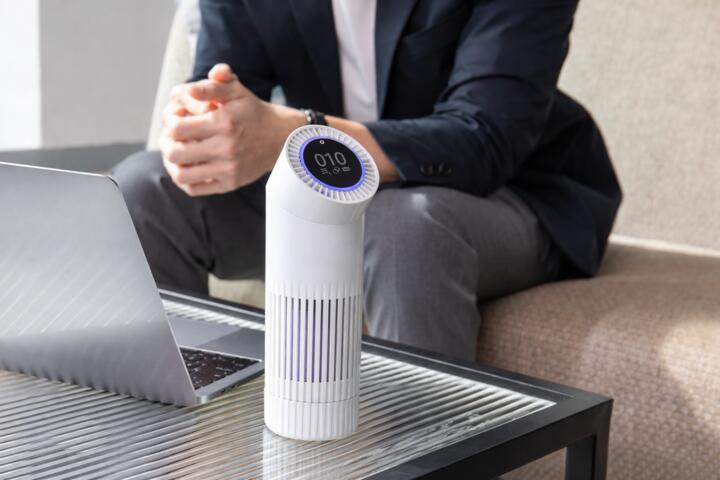
A travel purifier without a sensor is a "blind" device. In 2026, high-end portables include laser scattering sensors that provide real-time AQI feedback. This is crucial in hotel rooms where you might not realize that the "fresh air" vent is actually pumping in exhaust from a nearby highway. A sensor allows the device to auto-increase CADR when it detects a spike in pollutants.
Brands like Dyson have miniaturized their sensor tech into the "Dyson Zone" and related portable prototypes, allowing users to see the invisible. When the sensor light turns red, you know to keep the windows closed and the purifier on its highest setting until the CADR brings the levels back to a safe range (typically below 12 μg/m³).
Mobile Performance Cases
A consultant traveling to New Delhi during the 2025-2026 smog season used a high-CADR portable HEPA unit (CADR 75) in a 250-square-foot room. By running the unit on "Auto," the sensor detected PM2.5 levels of 180 μg/m³ inside the room upon arrival. The purifier brought the level down to 15 μg/m³ within 40 minutes, maintaining a safe environment despite the external AQI exceeding 400.
Conversely, a digital nomad in Bali used a 5W "ionizer wand" in a similar-sized room. Despite the device running for six hours, a separate AirVisual monitor showed no measurable decrease in particulate matter. The lack of physical filtration and sufficient airflow meant the device was effectively useless against the smoke from local agricultural burning, highlighting the danger of ignoring CADR ratings.
Performance Checklist
| Metric | Target Value | Priority | Benefit |
|---|---|---|---|
| Smoke CADR | 50+ CFM | Critical | Virus removal |
| Min. ACH | 4.8 Changes | High | Safety limit |
| Noise (Max) | < 50 dBA | Medium | Sleep quality |
| Power | USB-C 15W+ | High | Fan speed |
Common Mistakes
The most frequent error is placing a travel purifier on the floor. Most pollutants circulate at chest or head height, and floors are often where air movement is most restricted by furniture. For maximum effectiveness, place the unit on a bedside table or a desk, ensuring the intake and outlet are not blocked by curtains or walls.
Another mistake is leaving the hotel's "Eco" or "Auto" fan settings on while running your purifier. These systems often recycle air from other rooms. If you cannot disable the hotel's HVAC, run your purifier on its highest setting for the first hour of occupancy to "purge" the air, then switch to a maintenance speed.
Finally, travelers often forget to pack a spare filter for long trips. In highly polluted cities, a HEPA filter can reach its loading capacity in as little as 3-4 weeks. Carrying a fresh filter ensures that your CADR doesn't plummet mid-trip, leaving you unprotected when you need it most.
FAQ
Does CADR matter for a small car?
Yes. A car's interior is roughly 100 cubic feet. Even a low-CADR travel unit (CADR 20) can achieve over 10 ACH in a car. However, ensure the unit is secured; a loose air purifier can become a dangerous projectile during sudden braking or a collision.
Can I use it on a plane?
Most airlines allow portable air purifiers if they are battery-operated and do not produce ozone. However, plane air is already highly filtered via HEPA. A personal purifier's main benefit on a plane is the localized airflow it provides, which can help divert exhaled aerosols from a neighboring passenger.
What is "Theoretical Coverage"?
This is a marketing term used to describe the maximum space a unit can clean in one hour (1 ACH). Experts ignore this number and divide it by 5 to get the "Real-World Coverage" (roughly 5 ACH). If a box says 500 sq ft, expect it to actually handle 100 sq ft effectively.
Are H13 filters necessary?
In 2026, H13 (Medical Grade) HEPA is the industry standard for travel. It captures 99.97% of particles down to 0.3 microns. Avoid "HEPA-type" or "HEPA-like" filters, as these are often just unrated mesh that fails to capture the ultrafine particles that pose the greatest health risk.
Is TPA better than HEPA?
TPA is superior for long-term travel because the plates are washable, saving luggage space and money. However, HEPA is generally better at capturing specific large allergens like pollen instantly. TPA units also tend to be slightly heavier due to the internal electronics required for the plasma field.
Author's Insight
After testing dozens of portable units during my travels through Southeast Asia and the Pacific Northwest during wildfire seasons, I have realized that airflow is king. I once carried a very expensive, "silent" Swiss-made travel purifier that had a CADR so low it couldn't even clear the smell of a candle in a small room. Now, I never travel without a unit that has at least a 50 CFM Smoke CADR and a physical H13 filter. My practical tip: always run the unit on "High" for 20 minutes before you unpack your bags; it’s the only way to get a head start on the room's baseline pollution.
Summary
When selecting a travel-size air purifier in 2026, the CADR is the only metric that guarantees performance. Always verify that a device can provide at least 4.8 air changes per hour for your specific room size. Avoid underpowered USB units and prioritize H13 True HEPA or TPA technology with a Smoke CADR of at least 50 CFM. By focusing on airflow and filtration density rather than just "coverage" claims, you can maintain a safe breathing zone regardless of where your travels take you.