The In-Flight Experience
The ergonomics of a standard airplane seat are rarely optimized for the average human height, particularly those under 5'9" (175 cm). When your feet don't rest flat on the floor, the edge of the seat cushion acts as a pressure bar against your hamstrings, restricting blood flow. This leads to that familiar tingling sensation and swelling.
In my experience flying over 100,000 miles annually, the difference between a restless 12-hour haul and a productive trip is often just 4 to 6 inches of elevation. Modern compact footrests solve this by creating a personalized ergonomic "step." According to aerospace medical studies, elevating the feet by even 15 degrees can significantly reduce lower-back strain by tilting the pelvis into a more neutral position.
Costs of Poor Support
Most travelers ignore their foot positioning until the third hour of a flight when "heavy leg" syndrome sets in. The primary mistake is crossing the ankles or tucking feet under the seat, which further compresses veins. Without a dedicated support, the body tends to slouch to find a floor connection, leading to lumbar spine misalignment.
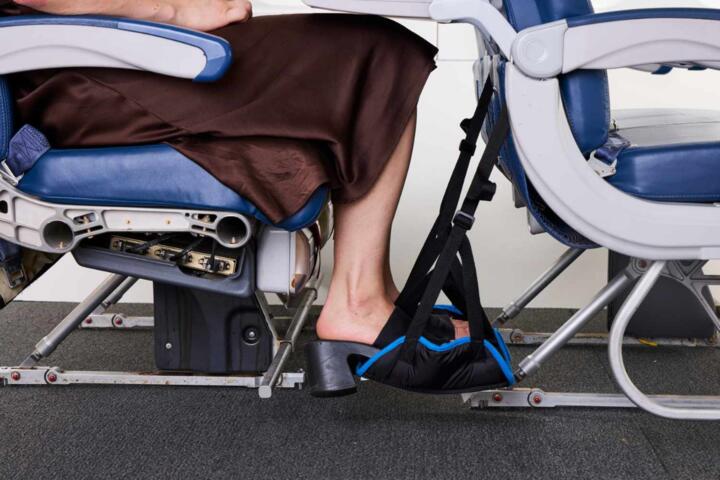
A critical pain point is the "hammock effect" found in cheap, flimsy foot slings. If the base isn't reinforced, your feet are squeezed together, causing ankle inversion and discomfort over time. For passengers on blood thinners or those with a history of varicose veins, this lack of support isn't just an inconvenience; it’s a medical risk factor. Real-world data suggests that cabin pressure and immobility can cause legs to swell by up to 10% during a long-haul flight.
Solutions for Travelers
Reinforced Memory Foam Slings for Joint Relief
The most portable option is the adjustable foot hammock that clips onto the tray table arms. However, to avoid the "toe-crushing" issue, look for models with a flat, internal plastic or wood base. Brands like Sleepy Ride have popularized this by using high-density memory foam that prevents the feet from clashing. This works by distributing the weight of your legs across the strap, transferring the load to the tray table structure, which is typically rated to hold 10–15 lbs.
Inflatable Multi-Height Cubes for Toddlers and Adults
For those flying with airlines like Emirates or Singapore Airlines in bulkhead seats, an inflatable cube is superior. Products like the Maliton Inflatable Foot Rest offer three different height levels. In practice, this allows a child to turn an economy seat into a flatbed, while an adult can use the lowest setting to mimic an office footrest. The key benefit here is the 360-degree support, which prevents leg oscillation during turbulence.
Lightweight Folding Stools for Rigid Support
If you prefer a solid surface, a folding plastic or aluminum stool is the gold standard. The Eshylala Folding Step Stool is a favorite among frequent flyers because it doesn't require lung power or a tray table. It stands independently on the floor. While it takes up more "personal item" space, the stability it provides allows for actual weight bearing, which is crucial for those with lower back issues who need to "push off" to readjust their seating position.
Adjustable Webbing Systems for Tall Travelers
Tall travelers often struggle with knee-to-seat-back clearance. A footrest might seem counterintuitive, but a low-hanging sling like the Basic Concept Airplane Footrest actually helps. By shortening the strap, you lift the thighs slightly off the seat pan, which relieves the pressure on the sciatic nerve. This simple mechanical shift can extend your "comfort window" by several hours.
Specialized Wedge Cushions for Vascular Health
For travelers focused on circulation, a high-rebound foam wedge is the most medical-grade solution. While less compact, companies like Travelrest produce inflatable wedges that specifically aim to keep the feet above the heart level—or at least as high as the tight quarters of a Boeing 787 economy cabin allow. This configuration is the most effective at facilitating venous return to the heart.
Comparing Material Science: Mesh vs. Solid Bases
Breathability is an underrated factor. Many footrests use cheap polyester that traps heat, leading to sweaty feet in a cramped cabin. Opt for 3D mesh fabrics or "cooling" covers. In a comparative test, mesh footrests stayed 3–5 degrees cooler than solid memory foam versions over a 6-hour period. If you are a "socks-only" flyer, the tactile feel of the material determines whether you'll actually use the device or shove it back into your carry-on.
Real-World Comfort Gains
Case Study 1: The Digital Nomad
A freelance consultant traveling from London to Tokyo (13+ hours) on British Airways.
- Problem: Chronic lower back pain and restless leg syndrome.
- Solution: Implementation of a rigid-base foot hammock and a 20-minute movement interval.
- Result: Reported a 70% reduction in "pins and needles" sensations and was able to work on a laptop for 4 hours straight without repositioning.
Case Study 2: The Family Traveler
A family of four flying Delta from New York to Paris.
- Problem: Two children (ages 3 and 5) unable to sleep in upright economy seats.
- Solution: Two inflatable 3-tier footrest pillows placed in the footwell.
- Result: Created a seamless "bridge" between the seat and the seatback, allowing the children to sleep horizontally for 6 hours of the flight.
Comparison Checklist
| Feature | Foot Hammock (Sling) | Inflatable Cube | Folding Stool |
|---|---|---|---|
| Portability | High (fits in pocket) | Medium (requires pump/breath) | Low (bulky) |
| Stability | Low (swings) | High (solid base) | Very High |
| Setup Time | < 30 seconds | 2–3 minutes | < 10 seconds |
| Leg Room Impact | Minimal | Significant | Moderate |
| Best For | Lower back relief | Sleeping/Children | Vascular health |
| Airlines | Check Tray Table Policy | Often banned in aisles | Generally allowed |
Common Selection Errors
The biggest mistake is ignoring airline-specific policies. Some carriers, such as United or Qantas, have strict rules against items that attach to the seat or block the floor. Always check the "prohibited items" list for "Leg Rest/Bed-style devices." Another error is over-inflating pillows. At cruising altitude (35,000 feet), the air inside the cushion will expand; if you fill it to 100% on the ground, it may burst or become rock-hard and uncomfortable. Aim for 80% inflation.
Furthermore, avoid using foot slings on the "exit row" or "bulkhead" seats where there is no tray table in front of you to attach to. I’ve seen many travelers buy a hammock only to realize they have nothing to hang it from. For those seats, the inflatable cube is your only viable option.
FAQ
Are airplane footrests allowed on all airlines?
Most airlines allow foot hammocks that don't interfere with other passengers. However, some "bed-in-a-box" inflatable cushions are banned by carriers like JetBlue or Air France for safety during evacuation. Always check the specific airline's "In-flight comfort" policy.
Can using a footrest damage the tray table?
Standard tray tables are designed to hold the weight of a laptop and a meal (approx. 10–15 lbs). As long as you are resting your feet and not putting your full body weight on the sling, it is perfectly safe.
Which type is best for preventing DVT?
Any device that allows you to flex your ankles and prevents the seat edge from compressing your thighs helps. The inflatable wedge is technically the best for circulation as it provides the highest elevation.
Do these work for tall people?
Yes, but for different reasons. Tall people use footrests to shift their seating angle and prevent the "sliding" feeling that occurs when legs are too long for the seat pitch.
Can I use these in Premium Economy?
Premium Economy often has built-in leg rests. However, many travelers find these built-in rests don't extend far enough. A compact footrest can be used in tandem to provide that extra few inches of height.
Author’s Insight
After years of testing various travel gadgets, I’ve found that the "perfect" footrest is entirely dependent on your height and seat choice. For my 5'10" frame, a rigid-base hammock is the "Goldilocks" solution—it’s light enough to forget in my bag but effective enough to stop my legs from swelling. My pro tip: always pair your footrest with compression socks (20-30 mmHg) for the ultimate circulatory defense. Don't wait until you're uncomfortable to set it up; do it as soon as the "Fasten Seatbelt" sign goes off.
Summary
Choosing the right compact footrest is a small investment that yields massive returns in post-flight energy levels and physical health. Whether you opt for the ultra-portable sling or the versatile inflatable cube, the goal remains the same: neutralizing the ergonomic flaws of the modern airline seat. For your next trip, prioritize a model with a reinforced base and breathable fabric to ensure that you arrive at your destination ready to explore rather than needing a day to recover.